
Guide
Sidechain Compression Without a Sidechain: Pumping
How to get sidechain compression without a sidechain: the classic kick-keyed pumping effect explained, then faster shortcuts that skip the routing.
You can get the pumping effect of sidechain compression without routing a sidechain by shaping the volume of the track directly, in time with the beat: a fast dip on each downbeat and a smooth swell back before the next one. A volume LFO, a drawn gain curve or a dedicated pump plug-in all do this. The classic method still matters, though, because knowing how it works tells you how deep and how fast your shortcut should be.
Why pumping works
Pumping started as a side effect. Engineers used a compressor on a bass or a pad and fed its detector from the kick drum, so the compressor turned the bass down every time the kick hit. The goal was clarity: the kick and the bass share the range from about 40 to 120 Hz, and moving the bass out of the way for a few tens of milliseconds lets the kick punch through without anyone turning anything up.
Push the same trick harder and it becomes a groove of its own. French house and much of modern EDM use deep ducking on pads, chords and even whole mix buses, so the music seems to breathe in and out with the kick. The ear hears the swell after each dip as forward motion, which is why a static pad suddenly feels like it is leaning into the next beat.
The classic method: a sidechain compressor
This works in any DAW with a compressor that has a sidechain input, including the stock ones.
- Put a compressor on the track you want to pump, such as the bass, pad or chord bus.
- Route the kick to the compressor's sidechain input. In most DAWs you pick the kick track, or a send from it, in the compressor's sidechain menu.
- Set a high ratio, 4:1 for subtle clarity, 10:1 or more for an obvious pump.
- Use a fast attack, 0.1 to 5 ms, so the dip lands right on the kick.
- Tune the release to the tempo. This is the setting that makes or breaks it. At 120 BPM a quarter note is 500 ms, so a release somewhere between 100 and 300 ms lets the sound swell back before the next kick. Too short and it clicks back; too long and it never recovers.
- Lower the threshold until you see 3 to 6 dB of gain reduction for clarity, or 10 dB and more for the full pumping effect.
A common refinement is a ghost kick: a muted kick track that plays only four on the floor and feeds the sidechain. It keeps the pump steady even when the real kick pattern has fills, gaps or a breakdown.
Shortcuts that skip the sidechain
Routing is fiddly, it breaks when you bounce stems or move a track to another project, and it means the pump depends on the kick being there at all. If you want the shape and not the dependency, there are three ways round it.
Draw it or use a volume LFO
Many DAWs let you draw a repeating volume curve, or offer a tremolo or gain plug-in with a tempo-synced LFO. Set it to quarter notes, use a shape that drops fast and rises slowly, and set the depth. This is free and precise, but drawn curves are tedious to adjust and simple LFO shapes rarely sound as natural as a compressor's release.
Use a dedicated pump plug-in
Undertow exists for exactly this. It makes a sound duck on every beat and swell back, the pumping of sidechain compression without setting up a sidechain. One lever sets how deep the pull is and how it returns, so instead of balancing ratio, threshold and release against each other you turn one control until the groove feels right. Because it needs no key input, it keeps working when you bounce, export or reuse the track elsewhere.
Duck with a key when you need it to follow the kick
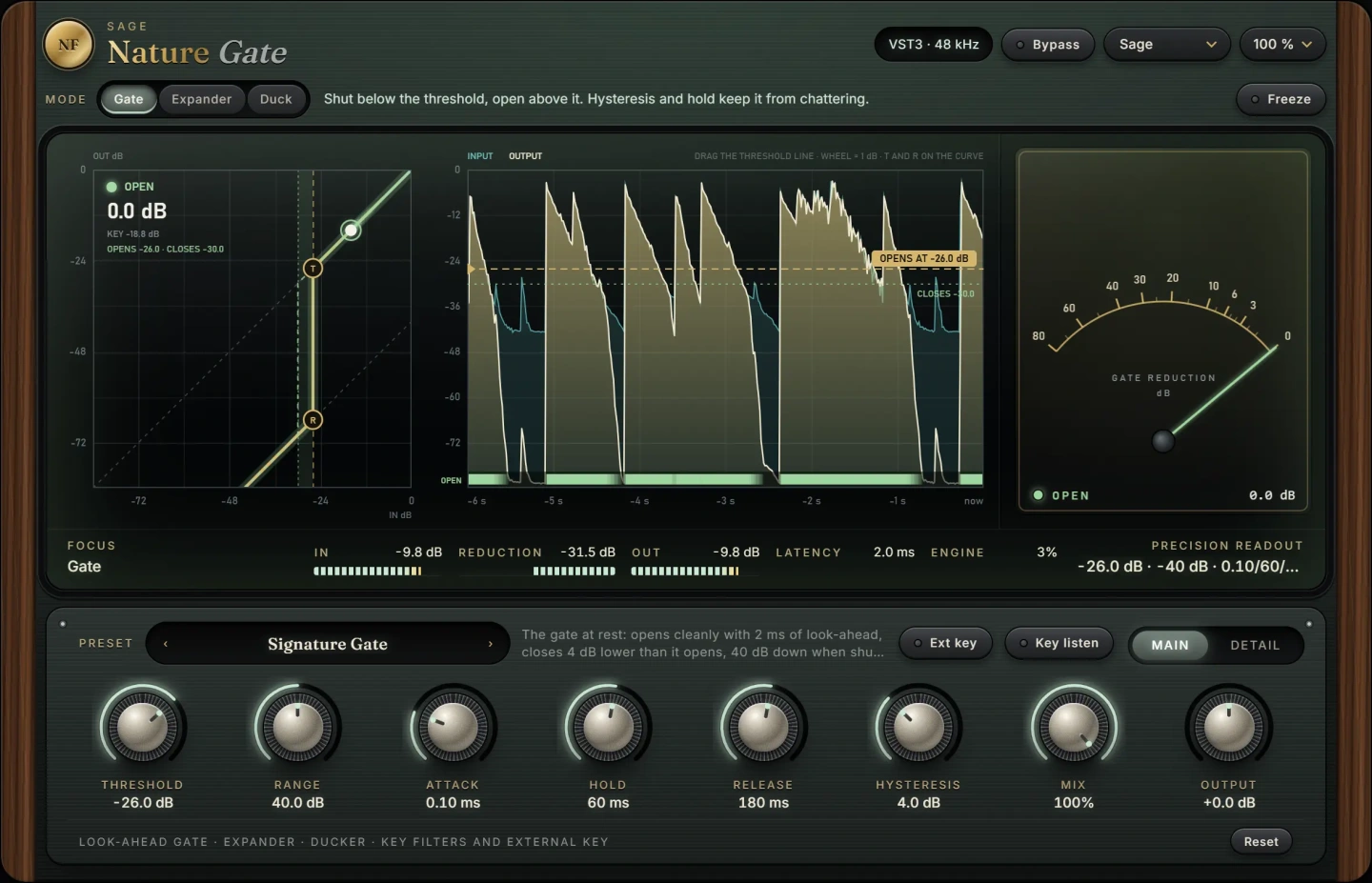
Sometimes you do want the dip to follow the actual drum part, fills and all. A ducker is a cleaner tool for that than a compressor. Nature Gate works as a gate, a gentler expander or a ducker, and it has its own filters on the key, so you can make it react only to the low end of a full drum loop rather than to the hats and snare. That gives you kick-following ducking even when you do not have the kick on its own track.
Common mistakes
- Pumping everything equally. If the pads, bass, vocals and effects all duck by the same amount, the mix loses its anchor. Pump the sustained parts hardest and leave the lead lighter or untouched.
- Release that fights the tempo. A swell that is still rising when the next kick lands sounds like a wobble, not a groove. Listen to where the sound is fully back and aim for just before the next beat.
- Clicks on the dip. An instant drop on a low bass can click. A millisecond or two of attack, or a slightly softer pump shape, fixes it.
- Forgetting the breakdown. With a real sidechain, the pump stops when the kick stops. That can be a feature, but if you want the breathing to carry through the breakdown, use a ghost kick or a beat-based tool.
- Judging it solo. Pumping that sounds extreme on its own often sits perfectly against the drums. Set the depth with the whole mix playing.
Questions
Can you sidechain without a sidechain input?
Yes. Anything that lowers the volume in time with the beat gives the same result: automation, a tempo-synced volume LFO, or a plug-in such as Undertow that produces the pump by itself. You only need a real sidechain when the dip has to follow an irregular part.
What release time should I use for sidechain pumping?
Start at about a quarter of the beat length and adjust by ear. At 120 BPM that is around 120 ms; at 128 BPM, around 115 ms. Longer releases give a slower, more obvious breathing; shorter ones give tighter clarity.
Should I sidechain the bass or the kick?
You duck the bass, pad or whatever competes with the kick. The kick is the trigger and stays untouched.
Does sidechain pumping work on the master bus?
It can, and some dance tracks do it on purpose, but it moves the kick too. A gentler approach is to pump a bus with everything except the drums, so the kick keeps its full punch. If the pumped parts also need width, see how to widen stereo without losing it in mono.
The plug-ins in this guide
 New
 New
More guides
- How to Mix Kick and Bass So They Work TogetherHow to mix kick and bass: decide who owns the sub, carve EQ space, duck the bass under the kick, check phase and keep the low end mono for…
- How to Remove Mic Bleed From a RecordingHow to remove mic bleed: prevent it at the session, then use gating, EQ, phase alignment, expanders and dedicated tools on drums, vocals…
- Noise Gate on Drums: Settings That Actually WorkUse a noise gate on drums: set threshold, hysteresis, attack, hold and release, filter the key and choose gate or expander to cut bleed…