
Guide
Mono Compatible Stereo Widening Without Phase Issues
Mono compatible stereo widening: how Haas, mid/side and detune widen a mix, why they cause phase issues, and how to check and keep the mono sum intact.
Stereo widening is mono compatible when whatever it adds to one side it takes away from the other, so the two channels still sum to the original sound. Mid/side processing works this way, while the Haas trick and heavy chorus do not, which is why they can make a part thin out or vanish on a phone speaker. Widen with methods that protect the mid, keep the bass centred and check in mono as you go.
Why widening causes phase problems
A stereo signal can be described as two parts: the mid, which is what the left and right channels share (L + R), and the side, which is how they differ (L - R). When a mix plays in mono, on a phone, a smart speaker, a club system or a broadcast, only the mid survives. The side is gone.
Most widening tricks create width by making the left and right channels different. If they become different in a way that also changes the mid, the mono sum changes: some frequencies cancel and the sound becomes hollow, thin or quieter. That is what people mean by phase issues. If the trick only adds side and leaves the mid untouched, mono stays exactly as it was.
The main widening methods
The Haas effect
Delay one channel by 5 to 35 ms and the ear hears one sound coming from the earlier side, with a sense of width. It is quick and dramatic, but in mono the delayed copy and the original combine into a comb filter, a series of notches that makes the sound phasey and hollow. Use it sparingly, on parts that matter less in mono, and keep the delay short and the delayed side lower.
Mid/side processing
Split the signal into mid and side, raise the side level, then convert back. Because only the side is changed, the mono sum is untouched. The limit is that it can only widen what is already different between the channels, so a mono source has no side to raise. M/S EQ is also useful: boosting the side above 3 to 5 kHz adds air and width without touching the centre.
Chorus, detune and doubling
Adding copies that are slightly detuned (5 to 15 cents is a common range) and slightly delayed, panned apart, gives a rich, wide sound, much like several players on one part. In mono, the copies still beat against each other, which sounds like gentle movement rather than cancellation, as long as there are several voices that wander independently. Two copies with a fixed offset are where the mono problems come in.
Real doubles
Recording a part twice and panning the takes hard left and right is still the most natural width there is. The takes differ in timing and pitch in random ways, so nothing cancels consistently in mono.
A step-by-step method that stays mono safe
- Put a mono check on the master. Most DAWs have a mono button or a utility plug-in that can sum to mono. Use it every few minutes, not only at the end.
- Keep the low end in the centre. Below about 100 to 150 Hz, cut the side or narrow to mono. Bass width wastes headroom, causes problems on vinyl and in clubs, and the ear barely locates it anyway.
- Widen the parts that need it, not the whole mix. Pads, backing vocals, rhythm guitars and effects returns are good candidates. Keep the kick, snare, bass and lead vocal centred and solid.
- Prefer M/S or multi-voice methods to Haas. Raise the side by a few dB, or add independent detuned voices, and check mono.
- Watch a correlation meter. Readings between 0 and +1 are safe. Readings that sit below 0 mean the channels are working against each other and the part will lose level in mono.
- Compare in mono at matched level. If the part drops in level or changes tone noticeably when you switch to mono, back off the widening.
Where NF Audios makes it faster
Canopy is stereo width on one dial that cannot disappear in mono. Whatever it adds to one side it takes from the other, so the mono sum stays as it was. It keeps the bass in the centre and gives a mono source real width, which covers the two cases a plain M/S widener cannot: protecting the low end automatically, and widening something that started out mono. If you widen most of your parts with one tool, this is the one to reach for, because the mono check becomes a formality.
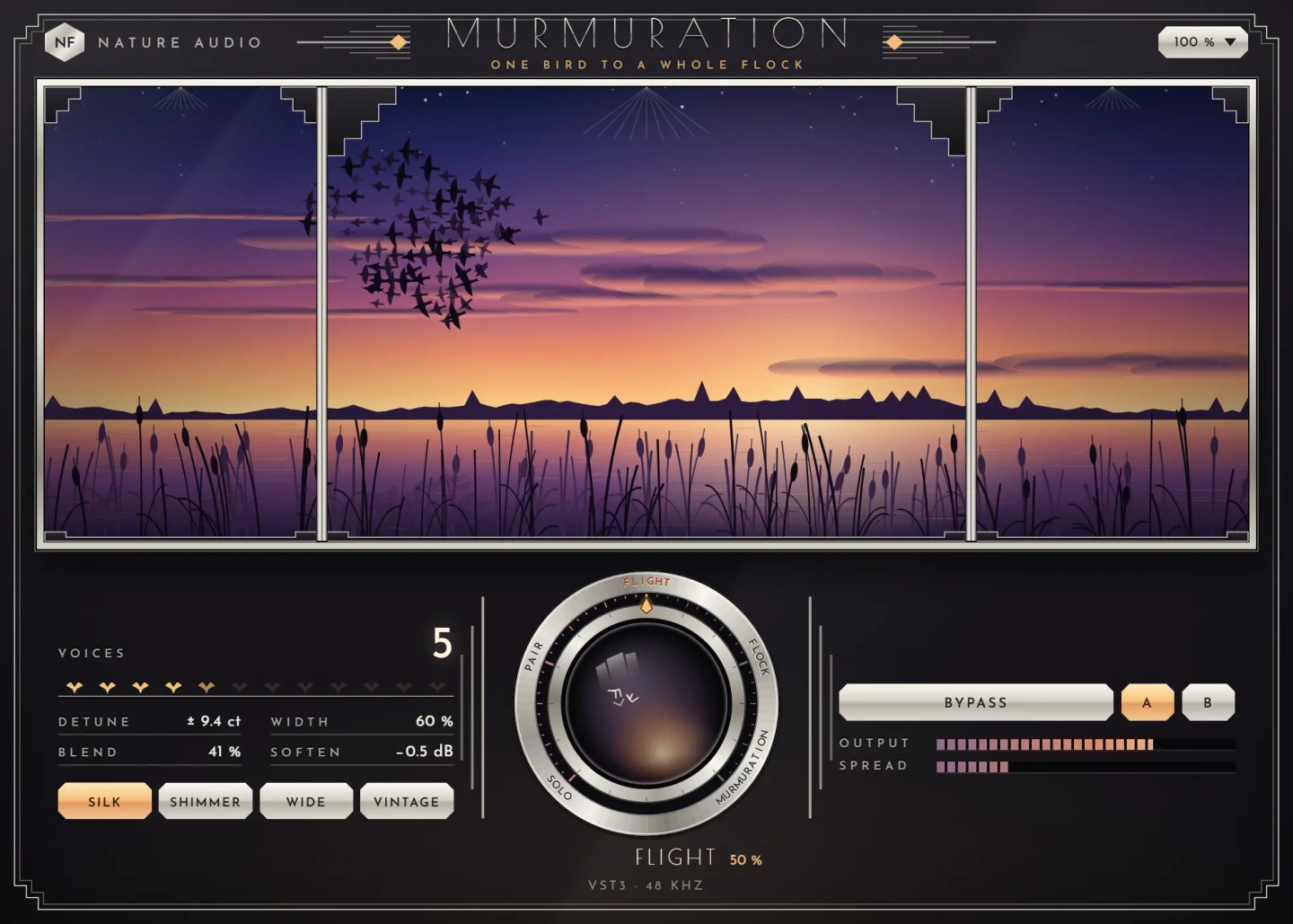
When you want the width of an ensemble rather than a wider version of one sound, Murmuration turns one voice into a flock. Up to eleven extra voices join, each wandering slowly on its own, with the detune and the width growing as the dial turns. Many independent voices are what keep a chorus-style widener from collapsing in mono, so it is a good fit for pads, synth leads and backing vocals. Check it in mono as you would any detune effect, and set the amount there.
Common mistakes
- Widening the master bus. It feels impressive for a minute, then the centre weakens and mono suffers. Widen individual parts or buses.
- Width in the bass. Stereo sub and low bass are the most common cause of a mix that sounds great on headphones and weak in a club.
- Everything wide. Width is relative. If every part is wide, the mix feels flat. Keep a strong centre so the wide parts have something to be wide against.
- Checking only at the end. By then a lot of decisions depend on the width. Check in mono as you build.
- Trusting headphones alone. Headphones exaggerate width. Listen on speakers and on a single small speaker too.
Questions
How do I widen stereo without phase issues?
Use methods that leave the mid untouched, such as mid/side widening or a widener that takes from one side what it adds to the other, keep the bass mono and check with a mono button and a correlation meter.
Is the Haas effect mono compatible?
Not fully. Summing a sound with a delayed copy of itself creates comb filtering. Short delays on less important parts can be acceptable, but check in mono every time.
How do I make a mono sound stereo?
Plain M/S widening cannot, because a mono source has no side signal. Use doubling, multi-voice detune, a stereo reverb or a widener designed to give mono sources width.
Should reverb be wide or mono?
Reverb returns are usually wide, and that is fine because reverb is decorrelated by nature. For a sound placed far back, keep the source itself narrower; see how to make a sound feel far away.
The plug-ins in this guide
 New
More guides
- How to Master a Song at Home: A Step-by-Step ChainHow to master a song at home: reference tracks, honest monitoring, an EQ, density, width, clipping and limiting chain, loudness targets…
- Mid Side EQ Explained: When and How to Use ItMid side EQ explained: how M/S works, when to use it on mixes and masters, side high-pass filters, mono bass, and the phase and width…
- Delay on Vocals: Slapback, Throws and Tape vs DigitalHow to use delay on vocals: slapback, 1/8 and 1/4 note throws, filtering and ducking the repeats, plus tape delay vs digital delay and…