
Guide
How to Make a Sound Sound Far Away in a Mix
How to make a sound sound far away in a mix: use level, high-frequency loss, pre-delay, early reflections and softer transients to place it deep.
To make a sound feel far away, copy what distance does in the real world: turn it down, roll off the highs, soften the attack and let more of the room than of the source reach the listener. Reverb alone pushes a sound back only a little; the combination of lost top end, blunted transients and a short pre-delay is what really places it in the distance. Do all of it in moderation and the sound sits deep without turning to mush.
Why distance sounds the way it does
Your brain judges distance from several cues at once, and a convincing mix gives it all of them.
- Level. In open air, sound loses about 6 dB each time the distance doubles. Quieter reads as further, but only alongside the other cues; a quiet but bright, dry sound just sounds small.
- High-frequency loss. Air absorbs high frequencies more than low ones, so distant sounds are duller. Above roughly 4 to 8 kHz the loss is noticeable over even modest distances.
- Direct-to-reverberant ratio. Close up, you hear mostly the source. Far away, the reflections from walls and the ground make up more of what you hear. This ratio is one of the strongest distance cues there is.
- Pre-delay and early reflections. When you are close to a source, the first reflections arrive well after the direct sound. As you move away, the direct sound and the reflections arrive closer together, so short or no pre-delay sounds further.
- Transients. Sharp attacks are mostly high-frequency energy, and they are the first thing distance smears. A far sound has softer edges.
- Width. A distant source takes up a smaller angle in front of you, so a far sound is usually narrower than a close one, even when its reverb is wide.
Step by step with any tools
- Start with level. Pull the fader down 4 to 8 dB against the elements you want in front. Do it first so you are not tempted to fix everything with reverb.
- Roll off the highs. Use a low-pass filter or a high shelf. A low-pass around 6 to 8 kHz for medium distance, and down to 3 or 4 kHz for very far, is a good starting range. A gentle cut of the lowest lows, below 80 to 150 Hz, also helps, because close sources have more bass from proximity.
- Soften the attack. A transient shaper with negative attack, or a slow-attack compressor set the other way round, takes the edge off. Even 2 to 4 dB less attack moves a drum or a pluck back.
- Narrow the source. Pull the stereo width of a stereo source in a little, or keep a mono source mono. Let the reverb provide the width.
- Send it to a reverb, and favour early reflections. Put the reverb on a send, set pre-delay short, 0 to 10 ms, and bring up the early reflections. For depth, the early reflections matter more than a long tail. A room or hall with a decay of 1.2 to 2.5 seconds suits most music.
- Turn the dry signal down, not just the send up. The goal is a lower ratio of direct to reverberant sound. On very far elements, the reverb can be louder than the dry signal.
- Add a darker echo for open spaces. Outdoors, distance shows up as a slap or echo off a far surface. A delay of 80 to 250 ms, filtered dark, with a little feedback, suggests a big open space far better than a huge reverb.
Where NF Audios makes it faster
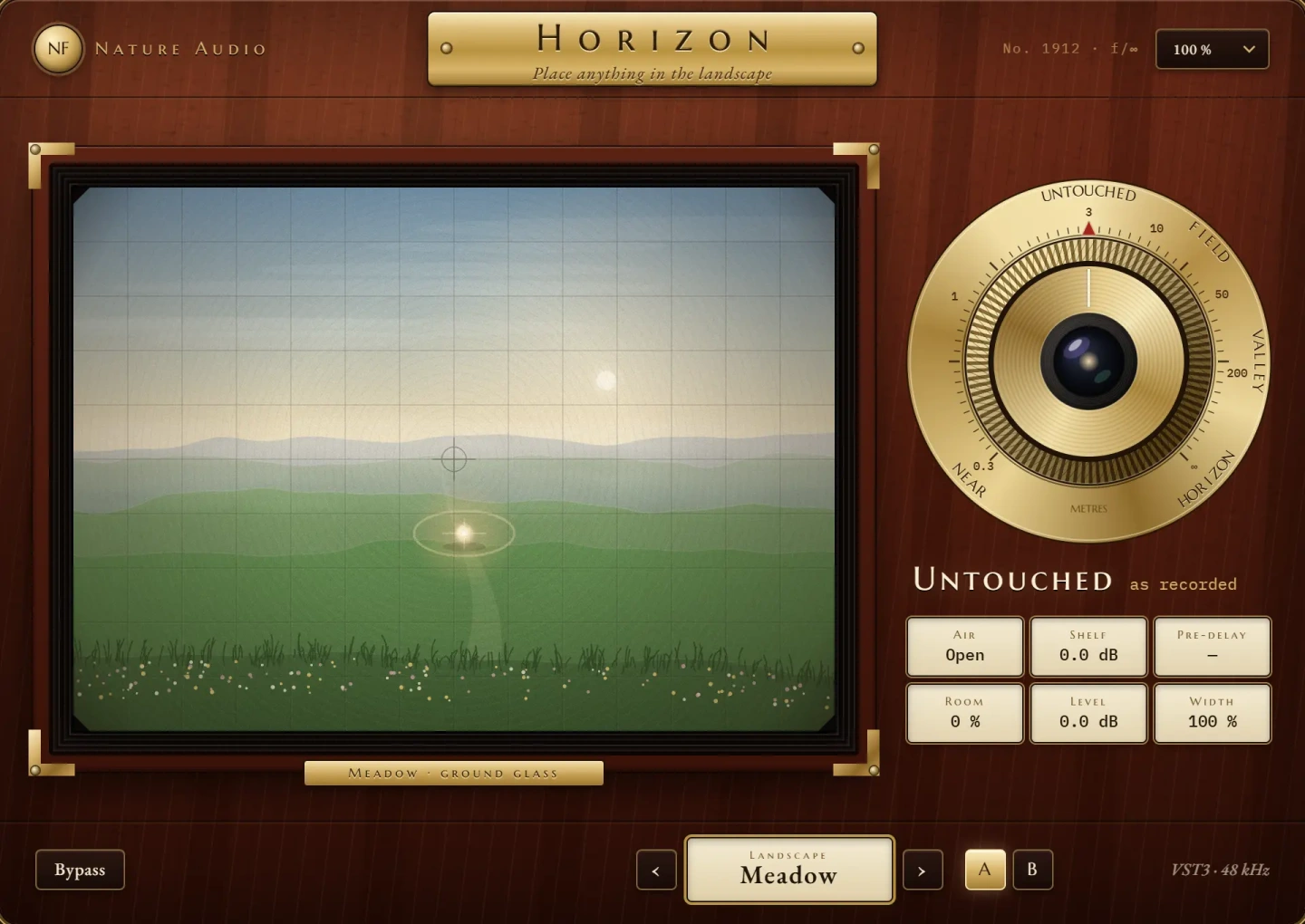
Doing all of that by hand means five or six plug-ins whose settings depend on each other. Horizon puts them on one move: it places a sound in a landscape, from right in front of you to far away. Near adds proximity, presence and air; far takes the highs as air does, softens the attack and brings in the landscape's reflections. That is the high-frequency loss, transient softening and early reflections from the steps above, changing together so they stay consistent.
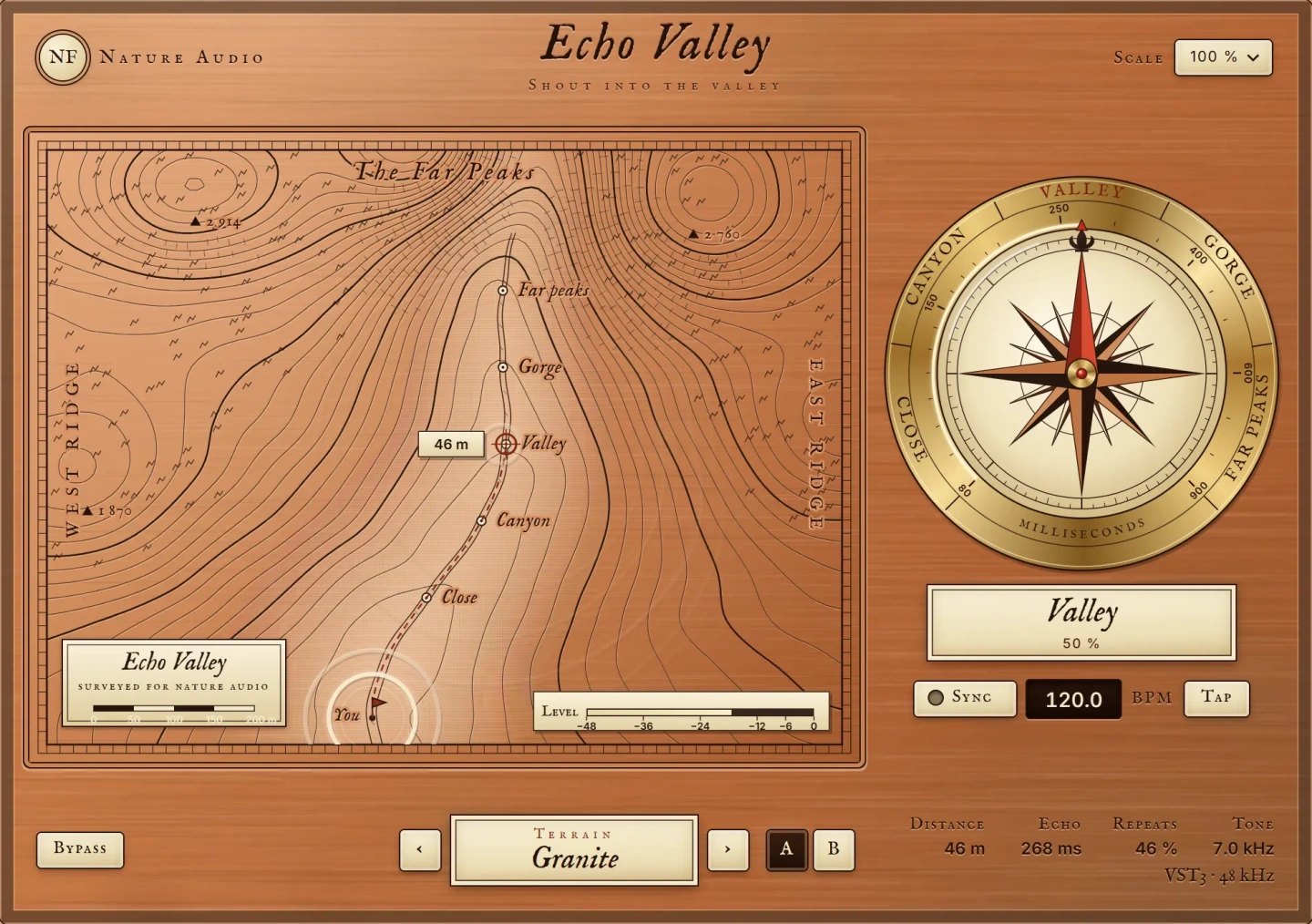
For outdoor distance, Echo Valley is an echo with one dial of distance. As the far wall moves up the valley, the echo takes longer to return, repeats more and comes back darker, wider and a little diffused, which is how a real echo behaves over distance.
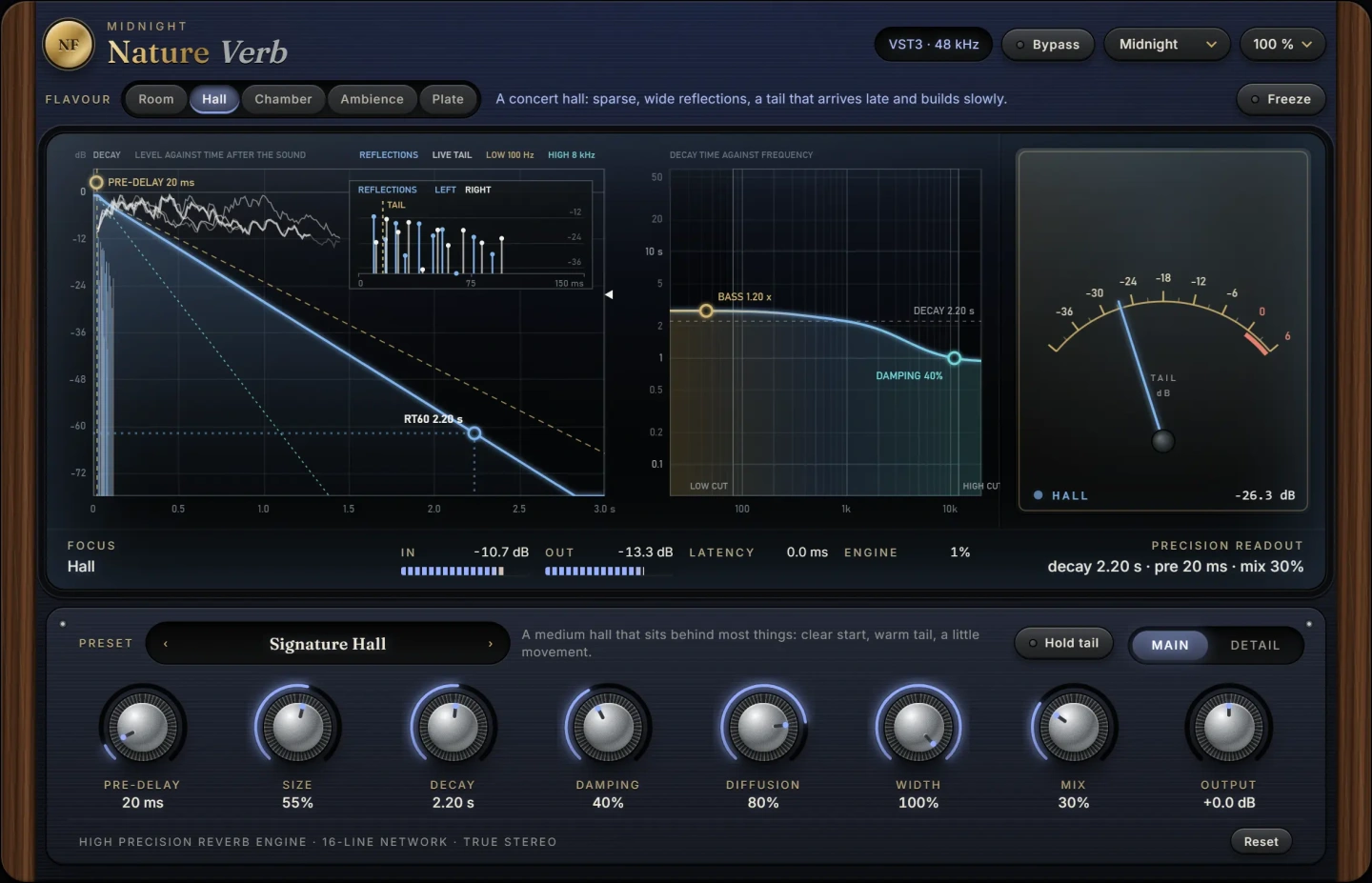
When you want a space built the traditional way on a send, Nature Verb builds its spaces from early reflections and a dense, slowly moving tail, with room, hall, chamber, ambience and plate flavours. The decay time you set is the decay time you get, so you can match the tail to the tempo and the distance you want.
Common mistakes
- Only adding reverb. A bright, punchy sound with lots of reverb sounds close and wet, not far. Cut the highs and soften the attack first.
- Long pre-delay on background parts. Pre-delay of 30 to 80 ms separates the dry sound from the room, which is great on a lead vocal you want in front. On a part you want far away it does the opposite.
- Everything far. Depth needs contrast. If every element is pushed back, nothing is. Keep a few elements dry, bright and close.
- Too much low end in the reverb. Filter the reverb return below 150 to 250 Hz so distant parts do not cloud the bass.
- Different spaces on every track. Two or three shared reverbs make a mix feel like it happens in one place. A different room per track feels like a collage.
Questions
How do you make vocals sound far away?
Lower the level, low-pass around 5 to 7 kHz, cut some low mids and bass, soften consonants with a de-esser or transient shaper, then send to a room with short pre-delay and turn the dry signal down. For a telephone-like or old-record distance, band-limiting further helps; see how to get a lo-fi, vintage tape sound.
Does reverb make a sound further away?
Partly. Reverb adds the room, but distance comes mostly from the balance of dry to reverberant sound, plus lost highs and softer transients. More reverb with the dry signal unchanged often just sounds wet.
What pre-delay makes a sound distant?
Short pre-delay, roughly 0 to 10 ms. The further you are from a source, the closer together the direct sound and its reflections arrive.
Should distant sounds be mono?
Often, or at least narrower. A distant source takes up a small part of the stereo field, while its reflections can spread wide around it.
The plug-ins in this guide
 New
More guides
- Reverb Types Explained: Room, Hall, Plate, ChamberReverb types explained: how room, hall, plate and chamber reverbs differ in decay, pre-delay and early reflections, and which type suits…
- Delay on Vocals: Slapback, Throws and Tape vs DigitalHow to use delay on vocals: slapback, 1/8 and 1/4 note throws, filtering and ducking the repeats, plus tape delay vs digital delay and…
- How to Compress Vocals: Ratio, Attack and ReleaseHow to compress vocals: ratio, attack and release settings that work, serial compression for an even vocal, levelling vs character and…