
Guide
Delay on Vocals: Slapback, Throws and Tape vs Digital
How to use delay on vocals: slapback, 1/8 and 1/4 note throws, filtering and ducking the repeats, plus tape delay vs digital delay and when to use each.
The most useful delays on vocals are a short slapback of 80 to 140 ms for thickness, and tempo-synced 1/8 or 1/4 note echoes for space and throws. Put the delay on a send, filter the repeats so they sit behind the voice, and duck them under the dry vocal so the echoes fill the gaps instead of blurring the words.
Why delay often works better than reverb on vocals
Reverb surrounds a vocal with a wash of reflections, which can push it back and cloud the words. Delay gives a sense of space with distinct repeats, so the vocal can stay close and dry while still sounding like it lives somewhere. That is why many modern pop, hip-hop and rock mixes lean on delay for vocal space and use reverb sparingly, or blend a little of both.
The four vocal delays worth knowing
Slapback
A single repeat, 80 to 140 ms after the voice, with little or no feedback. It thickens the vocal and gives it a sense of a hard surface nearby, the classic 1950s rock and roll and rockabilly sound. It does not need to be in time with the song; set it by ear so it reads as part of the voice rather than a separate echo.
Short doubling delay
Somewhere between 20 and 60 ms, often slightly different on left and right, low in the mix. It widens and thickens without sounding like an echo. Keep it quiet and check it in mono, because short delays can cause comb filtering when summed.
1/8 note delay
A tempo-synced eighth-note echo with feedback around 15 to 30 percent. It sits under the vocal as a constant sense of space, especially on faster songs. At 120 BPM an eighth note is 250 ms.
1/4 note delay and throws
A quarter-note delay (500 ms at 120 BPM) is longer and more obvious. It works as a constant effect on slower songs, but its best-known use is the delay throw: automating the send so only the last word of a line echoes into the gap that follows. Dotted eighth notes (375 ms at 120 BPM) are another favourite because the repeats fall between the beats.
To calculate any of these, 60,000 divided by the BPM gives a quarter note in milliseconds. Halve it for an eighth, and multiply the eighth by 1.5 for a dotted eighth.
Tape delay vs digital delay
A digital delay repeats the signal cleanly. Every repeat is a faithful copy of the first, just quieter. That clarity is useful for precise rhythmic echoes, but on vocals clean repeats can compete with the dry voice because they have the same brightness and detail.
A tape delay records the signal to tape and plays it back a moment later. Each pass through the machine adds a little saturation, loses some high end and picks up slight wow and flutter, so every repeat is darker and softer than the one before. Analog bucket-brigade delays behave similarly, with repeats that soften and darken. On vocals, this ageing is exactly what you want: the echoes step back naturally and stay out of the way of the lead.
In short, choose digital for crisp, rhythmic or obvious effects and tape or analog for repeats that sit behind the vocal with warmth. If you like the tape character more broadly, see how to make music sound vintage with tape.
Step by step: set up a vocal delay with any tools
- Use a send, not an insert. Create an aux or bus with the delay set to 100 percent wet. This lets you filter, compress and automate the echoes separately from the dry vocal.
- Choose the time. Slapback by ear, or sync to 1/8, dotted 1/8 or 1/4 notes.
- Set feedback. 0 to 10 percent for slapback, 15 to 30 percent for a steady echo, and 30 to 50 percent for a throw that trails off.
- Filter the repeats. Put a high-pass around 200 to 400 Hz and a low-pass around 4 to 8 kHz on the delay return. The repeats lose the boom and the sibilance, so they sound like an echo of the voice rather than a second singer.
- Duck the delay. Put a compressor on the delay return and feed its sidechain from the dry vocal. Set a fast attack, a release of 150 to 300 ms and 4 to 8 dB of reduction. The echoes drop while the singer is singing and bloom in the gaps.
- Set the level in the mix. Bring the return up until you notice the delay, then pull it back a couple of dB. Most of the time, the delay should be felt more than heard.
- Automate throws. Raise the send only on the words you want to echo, usually line endings.
Ducking uses the same idea as pumping effects; if you want to understand the mechanism more, read sidechain compression without a sidechain.
Where NF Audios plug-ins make it faster
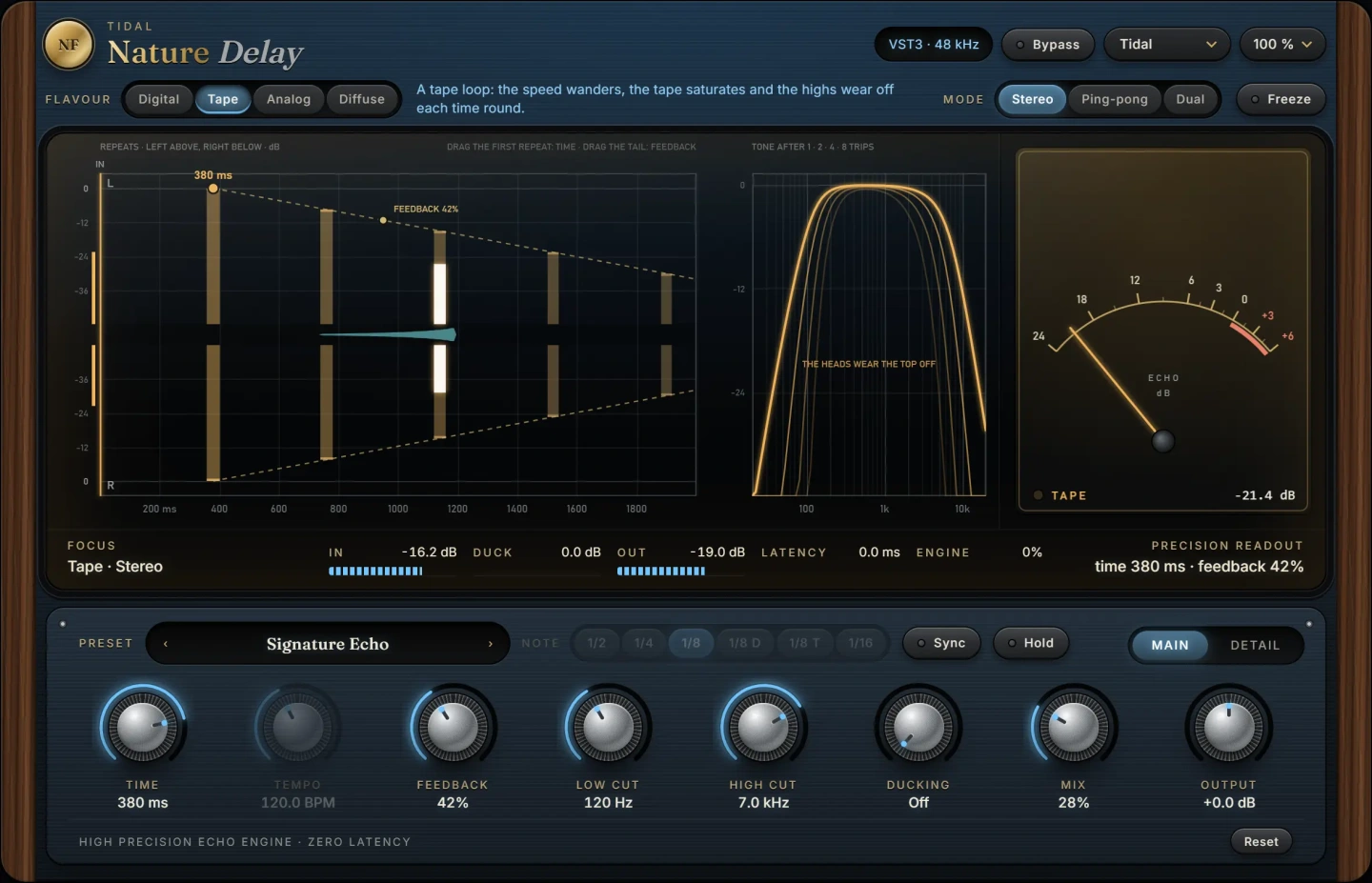
Nature Delay is an echo that stays in time with the song and offers digital, tape, analog and diffuse flavours. Its repeats age the way the real machines make them: each time round, a repeat passes through the flavour again, so the fourth repeat is darker and softer than the first. That covers the tape-versus-digital choice in one plug-in, and the natural darkening means a tape or analog flavour on a 1/8 or 1/4 note vocal delay already sits behind the voice before you reach for the filters. Use the digital flavour when you want a crisp, rhythmic echo, and diffuse when you want the repeats to soften into something closer to space.
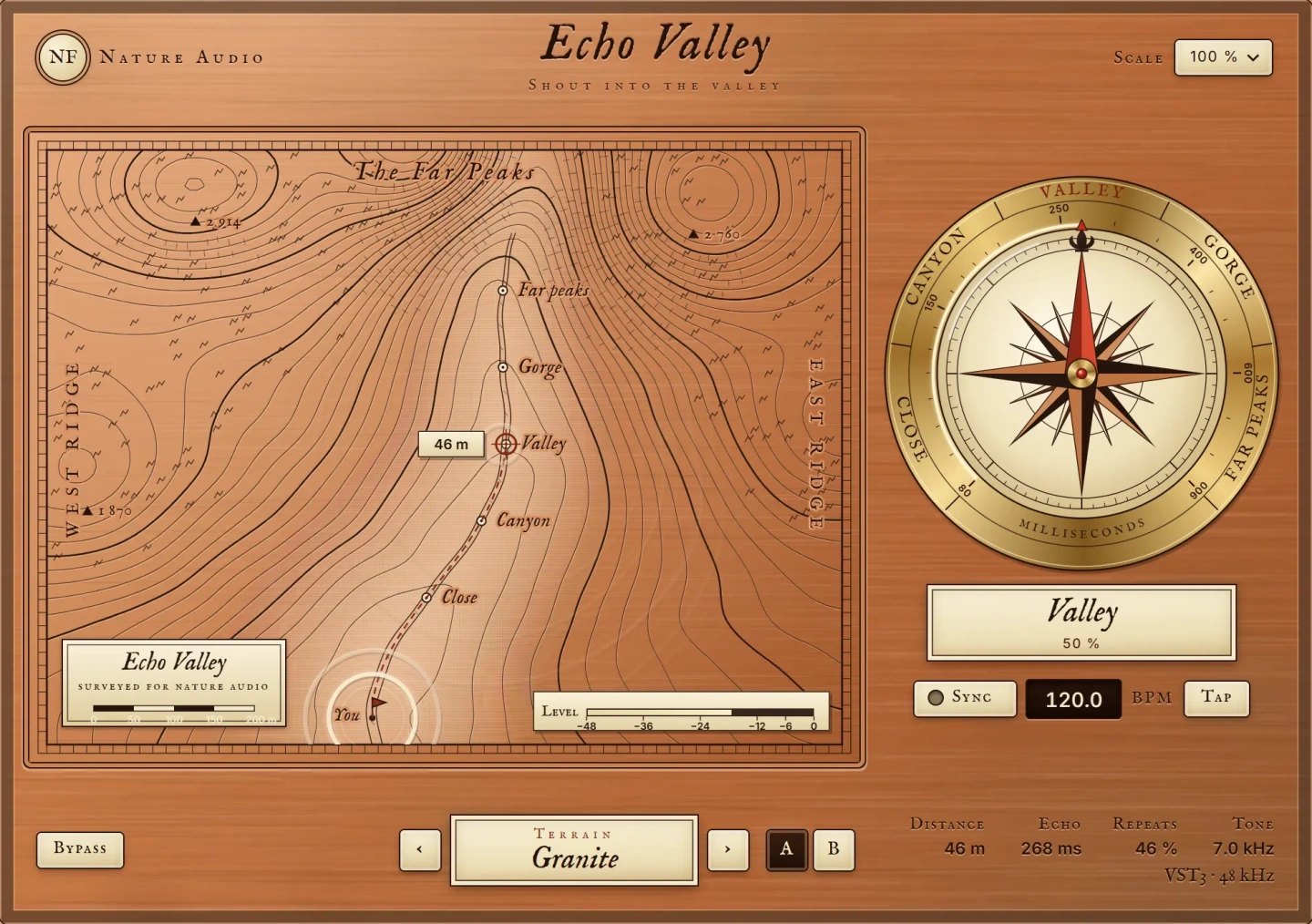
Echo Valley takes a different approach: one dial of distance. As the far wall moves up the valley, the echo takes longer to return, repeats more, and comes back darker, wider and a little diffused. That makes it quick for vocal throws and for big, open echoes on ballads and ambient tracks, where you want to decide how far away the echo is rather than set time, feedback and tone separately. A practical setup is Nature Delay on a short, synced send for constant space and Echo Valley on a second send for throws.
Common mistakes with vocal delay
- Unfiltered repeats. Full-range echoes clash with the dry vocal and make the mix sound cluttered.
- Too much feedback. Repeats pile up and smear the next line. Shorten the feedback or duck the return.
- Delay on an insert. You lose control of the echo's tone and level, and automating throws becomes awkward.
- Ignoring tempo. Unsynced long delays fight the groove. Slapback is the main exception.
- Too loud. If the delay is obvious all the time, it stops being an effect and starts being a distraction.
Questions
What delay time is best for vocals?
For slapback, 80 to 140 ms. For a steady echo, a tempo-synced 1/8 or dotted 1/8 note. For throws and slower songs, a 1/4 note. Calculate a quarter note as 60,000 divided by the BPM.
Should I use delay or reverb on vocals?
Delay keeps a vocal closer and clearer; reverb places it in a room. Many mixes use a filtered delay as the main space and a short, quiet reverb to glue it in.
Is tape delay better than digital delay for vocals?
Often, yes, because tape repeats get darker and softer each time and so stay behind the voice. Digital is better when you want crisp, exact repeats as an obvious effect.
How do I stop delay making vocals muddy?
Filter the repeats with a high-pass around 300 Hz and a low-pass around 5 kHz, keep feedback modest, and duck the delay return with a compressor keyed from the dry vocal.
The plug-ins in this guide
 New
More guides
- How to Make a Sound Sound Far Away in a MixHow to make a sound sound far away in a mix: use level, high-frequency loss, pre-delay, early reflections and softer transients to place…
- How to Compress Vocals: Ratio, Attack and ReleaseHow to compress vocals: ratio, attack and release settings that work, serial compression for an even vocal, levelling vs character and…
- How to EQ Vocals: A Step-by-Step GuideHow to EQ vocals step by step: high-pass the rumble, cut mud and nasal honk, then add presence and air. Frequencies, Q settings and common…