
Guide
How to Compress Vocals: Ratio, Attack and Release
How to compress vocals: ratio, attack and release settings that work, serial compression for an even vocal, levelling vs character and common mistakes.
To compress vocals, start with a ratio of 3:1 to 4:1, a medium attack of 10 to 30 ms, a release of 50 to 150 ms, and lower the threshold until loud phrases get 3 to 6 dB of gain reduction. For a more even, polished vocal, use two compressors in series, each doing a little, rather than one doing a lot.
Why vocals need compression
A singer's level moves constantly. Quiet words at the end of a phrase can be 10 to 20 dB below a belted chorus line, and in a full mix the quiet words disappear while the loud ones jump out. Compression narrows that range so every word sits at a steady distance from the listener. Fader automation and clip gain do part of the job, and they are worth using for big jumps, but a compressor handles the fast, syllable-to-syllable changes no one has time to draw by hand.
Compression on vocals usually serves one of two goals, and it helps to know which one you are after:
- Levelling: keeping the vocal even and present without the listener noticing any processing. Gentle ratios, moderate times, smooth behaviour.
- Character: using the compressor's attack, release and colour to make the vocal sound aggressive, dense or vintage. Faster timing, more gain reduction, an audible sound.
The controls, in vocal terms
Threshold and ratio
The threshold sets where compression begins; the ratio sets how hard it pushes back. On vocals, 2:1 to 4:1 covers most levelling work. Ratios of 6:1 to 8:1 or higher suit a fast peak-catcher or an aggressive rock or rap vocal. Watch the gain reduction meter: 3 to 6 dB on the loudest phrases is a sensible starting target for a single compressor.
Attack
Attack decides how quickly the compressor reacts. A fast attack (under 5 ms) clamps down on the start of each word and can make consonants sound soft or dull. A medium attack (10 to 30 ms) lets the front of the word through, which keeps the vocal articulate and punchy. Slower than that and the compressor mostly controls the sustained part of phrases.
Release
Release sets how quickly the compressor lets go. Too fast and you hear the level pumping up between syllables, along with breaths. Too slow and the compressor is still holding down the next word, so the vocal sounds squashed and lifeless. A release of 50 to 150 ms suits most vocals; set it so the gain reduction meter falls back between phrases in time with the rhythm of the singing.
Knee and makeup gain
A soft knee eases into compression and sounds more natural on levelling duty. A hard knee is more decisive. Use makeup gain to match the compressed level to the bypassed level so you are comparing tone and control, not loudness.
Step by step: compress a vocal with any compressor
- Fix big level jumps first. Use clip gain or automation to bring very loud or very quiet sections closer. A compressor works better when it is not fighting 15 dB swings.
- Clean the low end. High-pass the vocal before the compressor so plosives and rumble do not trigger it. A filter at 80 to 120 Hz is usually enough.
- Set a starting point. Ratio 4:1, attack 20 ms, release 100 ms, soft knee.
- Lower the threshold until the loudest phrases show 3 to 6 dB of gain reduction and quiet phrases show little or none.
- Adjust attack while listening to consonants. If words lose their edge, slow it down. If peaks still jump out, speed it up.
- Adjust release until the meter breathes with the phrasing and you hear no pumping.
- Match the output level and bypass to compare in the mix.
Serial compression: two stages, each doing less
Professional vocal chains often use two compressors in a row. The first is a fast peak-catcher: ratio around 6:1 to 8:1, fast attack (1 to 5 ms), fast release, catching only the loudest spikes with 2 to 4 dB of reduction. The second is a slower leveller: ratio 2:1 to 3:1, slower attack and release, smoothing the overall performance with another 2 to 4 dB. Because neither stage works hard, neither stage sounds strained, and the result is a vocal that is dense and even without sounding squashed. The opposite order also works: a smooth, slow compressor first for tone, then a fast one to trim whatever peaks remain.
Parallel compression is another option for character. Send the vocal to a bus, compress it hard (10 dB or more of reduction), and blend it in underneath the dry vocal for density without losing the natural dynamics.
Where an NF Audios plug-in makes it faster
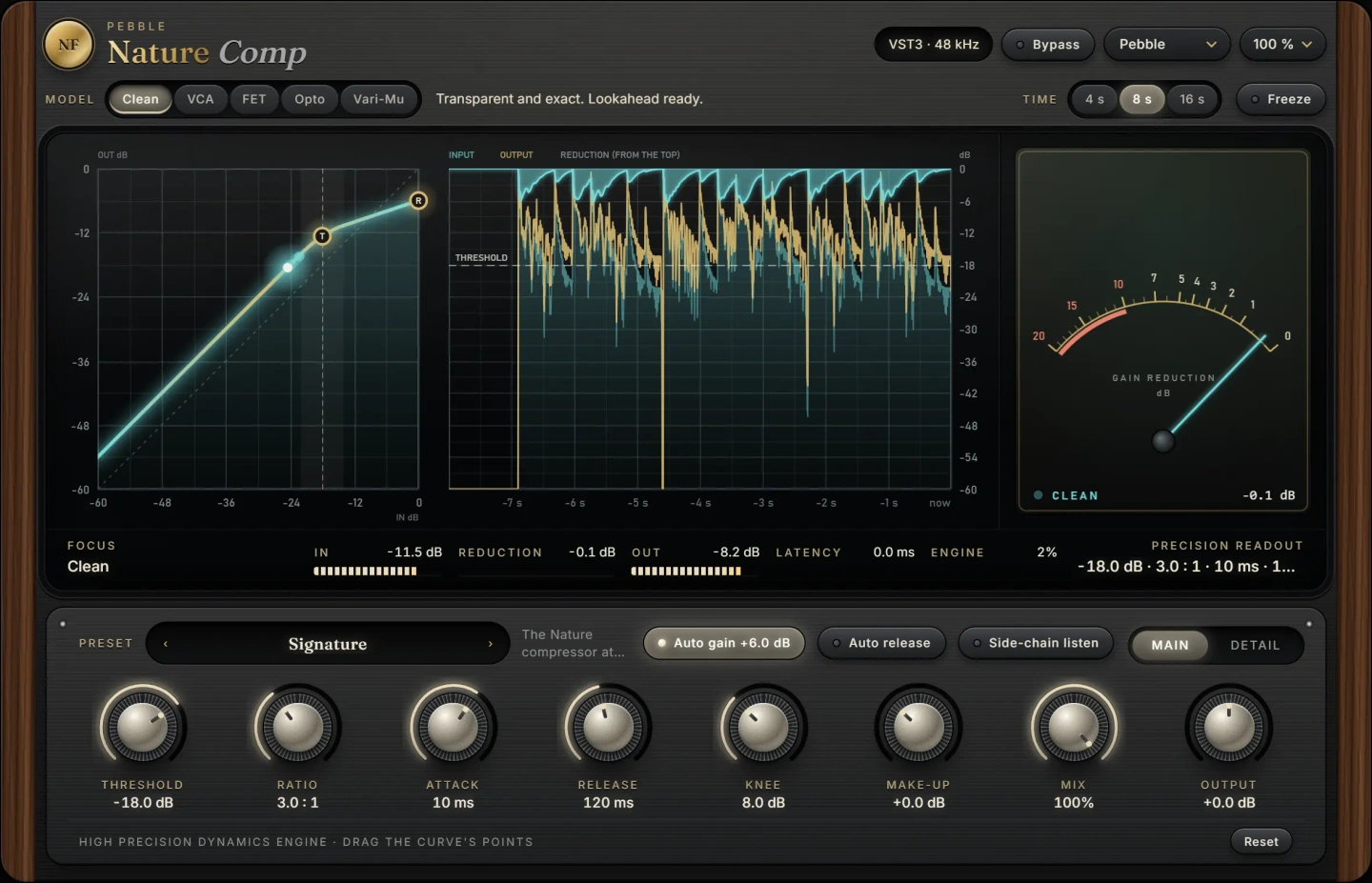
Serial compression usually means loading two different compressor models because each circuit type does a different job. Nature Comp puts five compressors in one: Clean, VCA, FET, Opto and Vari-Mu, each with its own detector, knee, timing and colour built on the same precise gain computer. A practical vocal chain is a FET instance for fast peak control followed by an Opto instance for smooth levelling, or Clean when you want control with no added colour. If you are not sure which family suits a vocal, our guide to VCA vs FET vs Opto compressors explains how each one behaves.
If you want a finished vocal tone without building a chain, Lantern levels gently as part of a single wheel that also tightens the low end, clears the low mids, adds warmth, presence and air, and de-esses at the bright end. It works well as the polish stage after a Nature Comp peak-catcher, or on its own for quick demos and podcasts.
Common vocal compression mistakes
- Too much gain reduction from one compressor. Ten dB from a single unit usually sounds flat and pumpy. Split the work across two stages.
- Attack too fast on a levelling compressor. The consonants go soft and the vocal sinks into the mix, so you turn it up and it gets harsh.
- Release too fast. Breaths and room noise rise between phrases. Slow the release or reduce the ratio.
- Compressing before cleaning up. Low-end thumps and plosives trigger heavy, unmusical gain reduction.
- Forgetting sibilance. Compression brings up S sounds relative to the vowels. Place a de-esser after the compressor if they start to cut.
- Judging louder as better. Always match the output level before deciding the compressor helps.
Questions
What is a good ratio for vocal compression?
3:1 to 4:1 is a reliable starting point. Use 2:1 for gentle, transparent levelling and 6:1 or higher for fast peak control or an aggressive sound.
How much gain reduction should a vocal have?
Around 3 to 6 dB on the loudest phrases from a single compressor. With serial compression the total can reach 6 to 10 dB while each stage stays gentle.
Should I use a fast or slow attack on vocals?
For most vocals, a medium attack of 10 to 30 ms keeps consonants clear. Use a fast attack only on a peak-catching stage or when you want an intentionally dense, flattened sound.
Should compression go before or after EQ on vocals?
Put corrective EQ such as a high-pass and mud cuts before the compressor, and tonal boosts like presence and air after it. That keeps the compressor reacting to the voice rather than to rumble.
The plug-ins in this guide
 New

More guides
- How to Make Vocals Sound Warm and PresentHow to make vocals sound warm and present: clear mud, add body around 200 Hz, tame harsh upper mids, saturate lightly and compress for a…
- How to EQ Vocals: A Step-by-Step GuideHow to EQ vocals step by step: high-pass the rumble, cut mud and nasal honk, then add presence and air. Frequencies, Q settings and common…
- How to De-Ess Vocals (Without Making Them Lisp)How to de-ess vocals: find sibilance at 5-10 kHz, set threshold, attack and release, and tame harsh S sounds without dulling the voice or…