
Guide
VCA vs FET vs Opto Compressor: Types Explained
VCA vs FET vs Opto compressor, plus Vari-Mu: how each circuit behaves, what it is best for, and typical attack, release and ratio settings to start from.
VCA, FET, Opto and Vari-Mu are four families of analogue compressor, named after the part that turns the gain down. VCA compressors are precise and punchy, FET compressors are very fast and aggressive, Opto compressors are smooth and slow, and Vari-Mu compressors are gentle and glue-like. Choose by the job: VCA for drums and buses, FET for energy, Opto for vocals and bass, Vari-Mu for the mix bus.
Why the circuit changes the sound
Every compressor measures the level of the signal and turns it down when it passes a threshold. What differs between circuits is how they measure, how fast they react, how soft the transition into compression is, and what colour the gain element adds. Plug-in emulations copy those behaviours, so the same names apply in software. Knowing the families helps you pick the right compressor in seconds instead of trying them all on every track.
VCA compressors
A VCA (voltage-controlled amplifier) compressor uses a chip that follows a control voltage very accurately. That gives fast, repeatable, predictable compression with clearly defined attack, release and ratio controls. The sound is clean to slightly punchy, which is why VCA designs are the classic choice for drum buses and mix bus glue.
Typical settings:
- Mix bus: ratio 2:1, attack 10 to 30 ms, release 0.1 s or auto, 1 to 3 dB of gain reduction.
- Drum bus: ratio 4:1, attack 10 to 30 ms to let the hit through, release timed to the groove, 3 to 6 dB of gain reduction.
- Snare or kick for punch: ratio 4:1 to 6:1, attack 5 to 20 ms, fast release.
FET compressors
FET (field-effect transistor) compressors are the fastest of the four. Attack times can be well under a millisecond, so they can grab transients before they pass, and they add audible harmonic colour when pushed. They sound energetic and forward rather than transparent. FET designs are favoured for rock vocals, room mics, bass guitar and parallel drum compression.
Typical settings:
- Aggressive vocal: ratio 4:1, fast attack, medium release around 50 to 100 ms, 5 to 8 dB of gain reduction.
- Parallel drums: ratio 8:1 or higher, fastest attack and release, heavy gain reduction, then blend 20 to 40 percent under the dry drums.
- Bass guitar: ratio 4:1, medium attack around 10 ms so the pluck survives, medium release.
Opto compressors
An opto (optical) compressor uses a light source and a light-dependent resistor. The light gets brighter as the signal gets louder, and the resistor responds with a natural lag. Attack is relatively slow and release is program-dependent: it recovers quickly at first and then slowly, often over a second or more after heavy compression. The result is smooth, musical levelling that rarely sounds grabby. Opto compressors are the default choice for vocals, bass and anything that needs to sit evenly without sounding processed.
Typical settings:
- Vocal levelling: ratio around 3:1 or the unit's fixed setting, 3 to 6 dB of gain reduction on louder phrases.
- Bass: 3 to 5 dB of gain reduction for an even level under the kick.
- Many opto designs only have gain and peak reduction controls, because the timing is part of the circuit.
Vari-Mu compressors
Vari-Mu (variable-mu) compressors use valves whose gain changes with the bias voltage. The ratio increases as the signal gets louder, so the knee is very soft: light signals get almost no compression, loud ones progressively more. Timing is gentle and the valves add warmth. Vari-Mu designs are prized on the mix bus and in mastering, where you want 1 to 2 dB of glue that you feel more than hear.
Typical settings:
- Mix bus or mastering: slowest or medium attack, medium release, 1 to 2 dB of gain reduction.
- Vocal or acoustic bus: 2 to 3 dB for warmth and cohesion.
How to choose: a quick method with any compressor
- Decide the job. Catching peaks, levelling a performance, adding punch, or gluing a group are different tasks.
- Pick the family. Peaks and energy: FET. Levelling: Opto. Punch and control: VCA. Glue: Vari-Mu or VCA.
- Set the threshold for the right amount of gain reduction. Start with the numbers above and watch the meter.
- Tune attack and release to the tempo. The gain should recover before the next hit. If the meter never returns to zero between notes, the release is too slow.
- Match the output level and compare. Use make-up gain so bypass is at the same loudness, otherwise you are judging volume, not compression.
Stock compressors in most DAWs work for this. Many offer modes or models labelled after these families; if yours has only one mode, you can get close by adjusting attack, release and knee: fast attack and hard knee for FET-like behaviour, slower attack, soft knee and slow release for Opto or Vari-Mu.
Where Nature Comp makes it faster
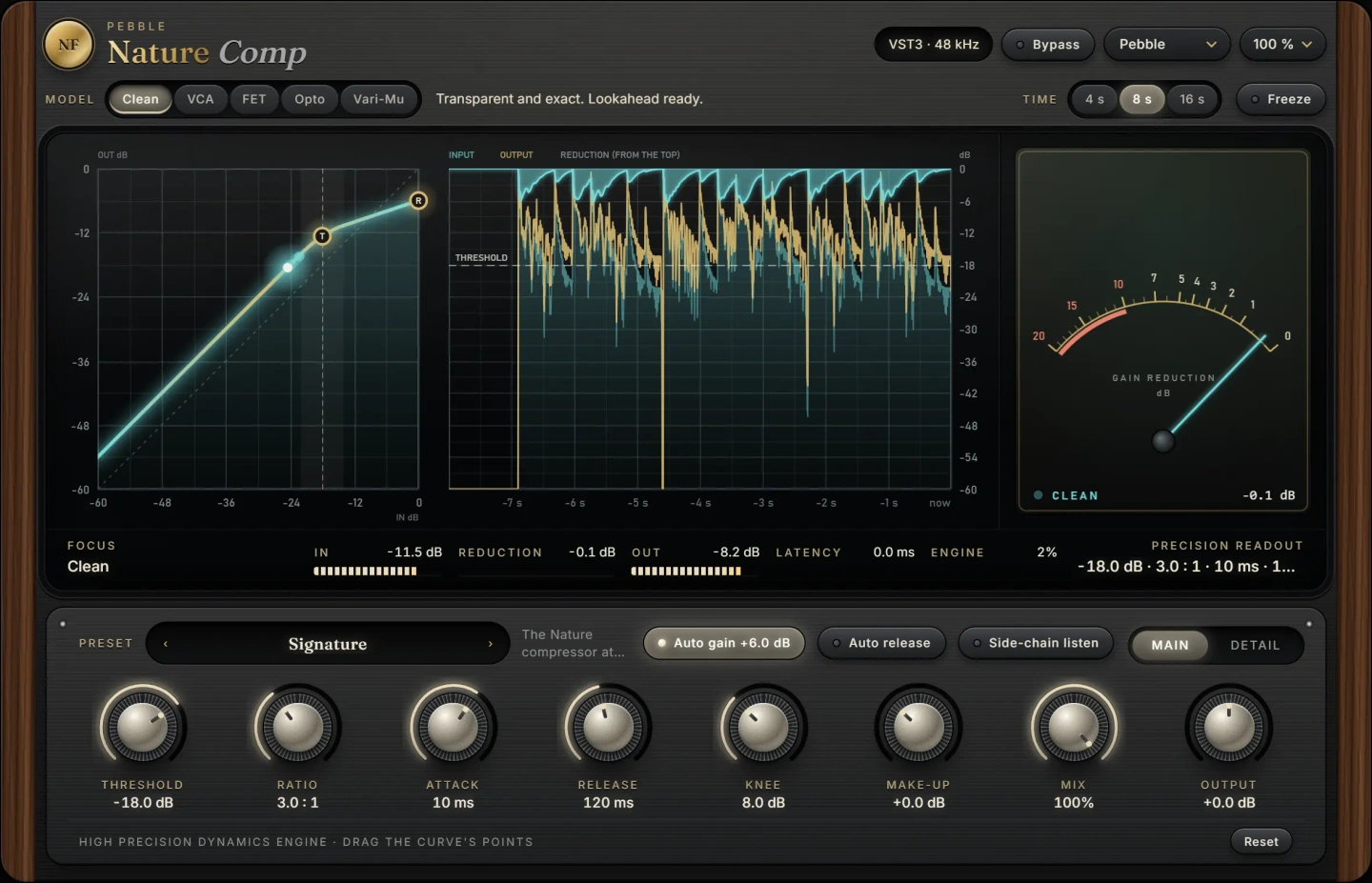
Switching between four separate compressor plug-ins while you decide is slow, and it changes the gain structure every time. Nature Comp is five compressors in one: Clean, VCA, FET, Opto and Vari-Mu. The same precise gain computer is bent the way the classic circuit families behave, each with its own detector, knee, timing and colour. That means you can audition the four circuit types on one track, in one plug-in, and keep the one that suits the part. It is available as VST3 for macOS and Windows.
Common mistakes
- Too fast an attack on drums. An attack under a few milliseconds on a VCA or FET removes the hit you were trying to emphasise.
- Using a FET for transparent levelling. It will add colour and movement. Reach for an Opto instead.
- Expecting a Vari-Mu to control peaks. Its soft knee and gentle timing let fast transients through. Put a limiter or clipper after it if peaks matter, as covered in how to make a master louder.
- Too much gain reduction on one stage. Two compressors doing 3 dB each usually sound better than one doing 6 dB. A classic chain is FET to catch peaks, then Opto to level.
Questions
What is the difference between VCA and FET compression?
Both can be fast, but a VCA is cleaner and more precise, while a FET is faster at its quickest settings and adds more harmonic colour. VCA suits buses and controlled punch; FET suits aggressive vocals and parallel drums.
Which compressor type is best for vocals?
Opto is the most common starting point because it levels smoothly. Many engineers put a FET first to catch peaks and an Opto after it for even level.
Is Vari-Mu the same as a tube compressor?
Vari-Mu is a specific type of tube compressor where the valve itself provides the gain reduction. Some other compressors use tubes only in the output stage for colour.
Do I need all four compressor types?
No, but having a fast, colourful option and a smooth, slow option covers most mixing. VCA and Vari-Mu behaviour help most on buses.
The plug-ins in this guide
 New
More guides
- How to Compress Vocals: Ratio, Attack and ReleaseHow to compress vocals: ratio, attack and release settings that work, serial compression for an even vocal, levelling vs character and…
- How to Make Vocals Sound Warm and PresentHow to make vocals sound warm and present: clear mud, add body around 200 Hz, tame harsh upper mids, saturate lightly and compress for a…
- Delay on Vocals: Slapback, Throws and Tape vs DigitalHow to use delay on vocals: slapback, 1/8 and 1/4 note throws, filtering and ducking the repeats, plus tape delay vs digital delay and…