
Guide
How to Make Music Sound Vintage: Lo-Fi Tape Effect
How to make music sound vintage with a lo-fi tape effect: wow and flutter, saturation, band-limiting and noise, step by step with any plug-ins.
To make music sound vintage, recreate the flaws of the old medium it was recorded on: slow pitch drift and fast wobble from the tape transport, gentle saturation, a narrower frequency band, a narrower stereo image, and a bed of hiss or crackle. Each flaw on its own is small. Together, and in the right proportions, they make a sound read instantly as old.
Why old recordings sound old
The vintage sound is not one effect. It is the fingerprint of the equipment, and each part has a cause.
- Wow and flutter. Tape and vinyl never moved at a perfectly steady speed. Wow is slow pitch variation, roughly 0.5 to 2 Hz, from things like a warped reel or an off-centre record. Flutter is faster, about 5 to 15 Hz and above, from the capstan and rollers. Wow makes sustained notes drift; flutter gives a slight shimmer or roughness.
- Saturation. Tape, valves and transformers add harmonics and round off peaks as they are driven harder. Tape in particular compresses transients softly and adds mostly low-order harmonics, which reads as warmth.
- Band-limiting. Old formats did not reproduce the full range of hearing. Cassettes and worn tape lose top end; old radio and gramophone recordings may span only a few hundred hertz to a few kilohertz. A narrow band is one of the most recognisable vintage cues.
- Narrow stereo, or mono. Most music before the late 1960s was mono, and worn stereo tape loses separation. Less width sounds older.
- Noise. Tape hiss, vinyl crackle and mains hum at 50 or 60 Hz were always there. Listeners now hear them as a signature of age.
- Dropouts. Worn or damaged tape briefly loses contact with the head, causing small drops in level and tone.
Step by step with any tools
- Start with saturation. Put a tape or saturation plug-in first and drive it until peaks round off, usually 1 to 3 dB of apparent compression. Keep it subtle for warmth, push it for grit.
- Add wow and flutter. Use a tape plug-in or a modulated delay or chorus with a very short delay and no dry signal. For wow, a rate below 1 Hz and a depth of a few cents; for flutter, a faster, shallower modulation. Pitch drift on piano and sustained chords sells the effect more than anything else.
- Band-limit. High-pass at 80 to 200 Hz and low-pass at 6 to 10 kHz for a tape or cassette sound. For an old radio or gramophone, go to roughly 300 Hz to 3 kHz. Add a small resonant bump near the cut-offs if your filter allows it, as old machines were rarely flat.
- Narrow the image. Reduce stereo width by 30 to 60 percent, or sum to mono for an older era.
- Add noise last, and quietly. Hiss or crackle well below the music, around -40 to -30 dB relative to the music, is enough. It should be felt in the quiet parts, not heard over the chorus.
- Bounce and listen on small speakers. Vintage processing is easy to overdo on studio monitors and easy to underdo on a laptop. Check both.
Where NF Audios makes it faster
Setting six effects so they agree with each other takes time, and the era you are aiming for decides all of them at once. Fossil ages a sound, from today to ancient. As the dial turns, the medium takes over: wow and flutter, saturation, a narrowing stereo image, dropouts, hiss, crackle and hum, and a band that closes in. That is the whole list above on one control, which makes it quick to find the age that suits the track.
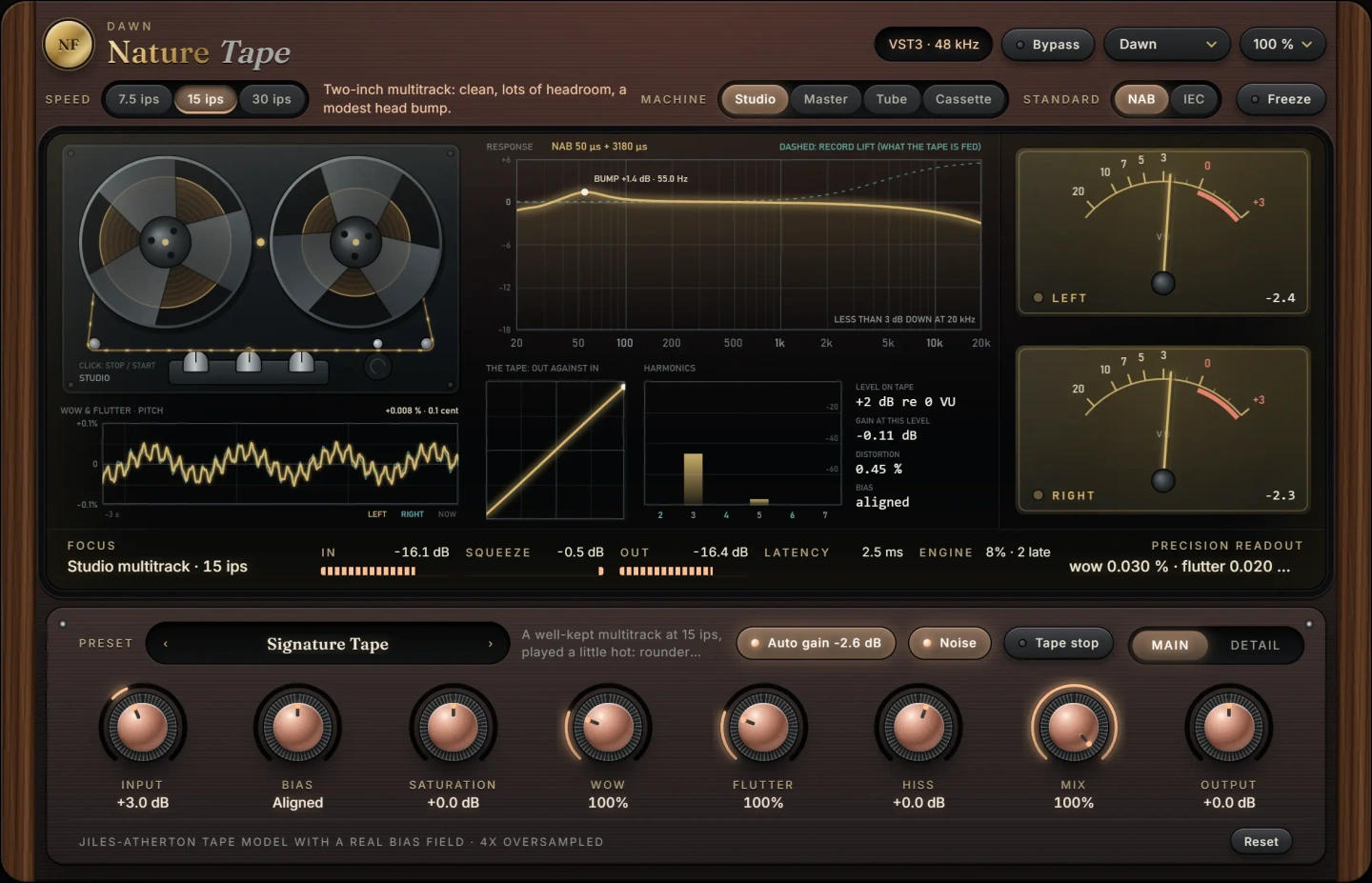
If you want a tape machine in particular rather than general ageing, Nature Tape is a tape machine modelled from the tape outwards: the magnetic behaviour of the tape itself with its bias, then the heads, the transport and the electronics around it. Its four machines and real reels cover bias, wow, flutter and hiss, so it suits drums, buses and full mixes where you want tape character without the full lo-fi treatment.
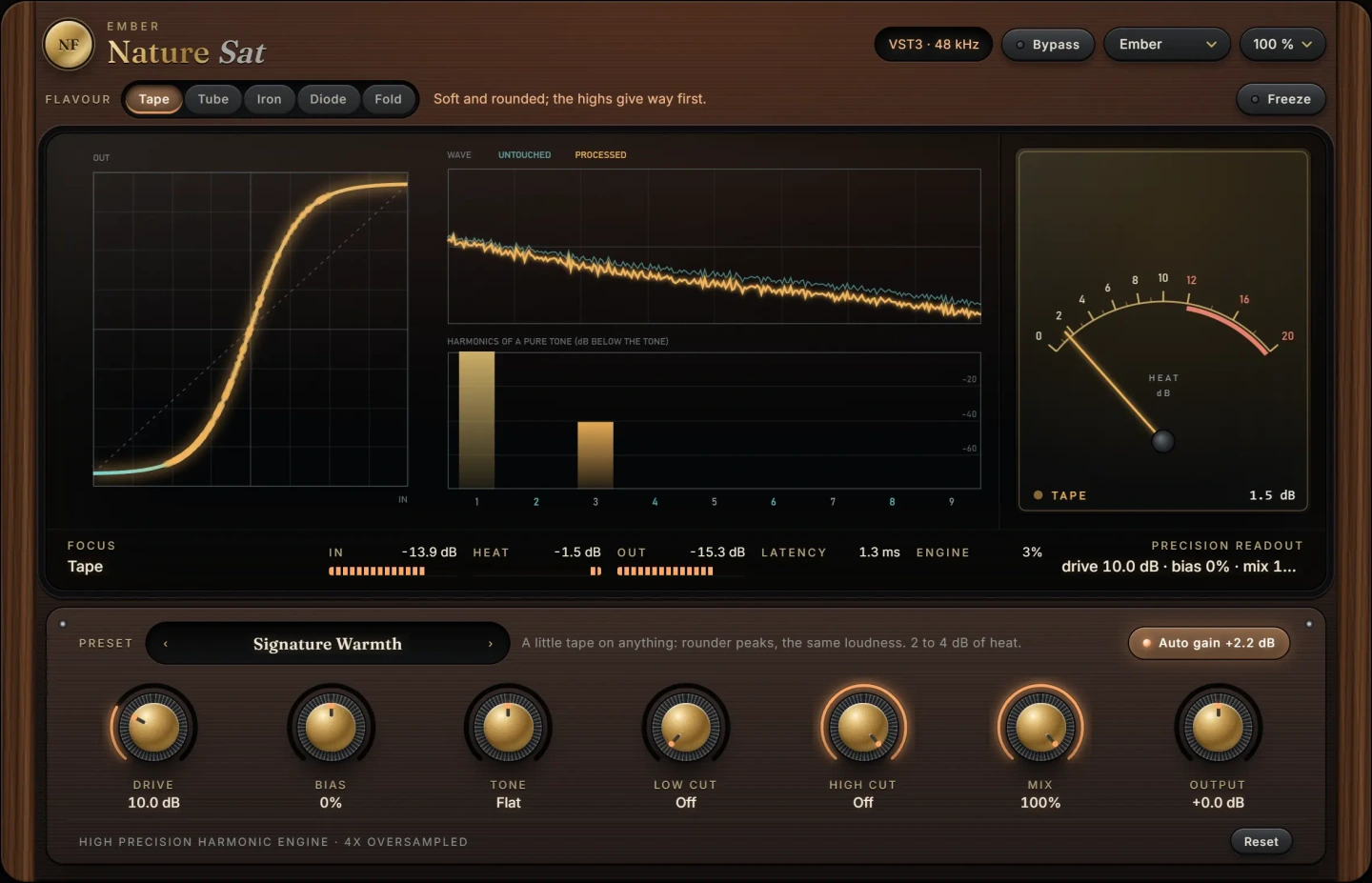
For warmth alone, Nature Sat adds harmonics from a little warmth to fire. Its five flavours run at four times the sample rate, so what they add stays musical instead of folding back into the sound as digital grit. That matters for vintage work, because harsh aliasing is the opposite of the soft, rounded sound you are after.
Common mistakes
- Too much wow. Heavy pitch wobble makes a track sound out of tune rather than old. Set it until you notice it on held notes, then back off a little.
- Noise louder than the music. Crackle at the level of the snare is a parody. Keep it under the quiet parts.
- Processing the drums the same as everything else. Lo-fi on the whole mix can make the kick weak. Treat melodic parts harder and drums lighter, or band-limit the drums less.
- Modern width with vintage tone. A wide, modern stereo image undermines the effect. Narrow it along with the tone.
- Losing the low end entirely. A tight high-pass sounds authentic, but modern listeners still expect some bass. Decide the era deliberately and adjust the high-pass to match.
Questions
How do you get a lo-fi tape effect?
Combine gentle tape saturation, slow pitch wow and faster flutter, a high-pass and low-pass to narrow the band, reduced stereo width and a little hiss. A single ageing plug-in can set all of these together.
What is the difference between wow and flutter?
Both are speed variations in playback. Wow is slow, under about 4 Hz, and sounds like drifting pitch. Flutter is faster and sounds like a shimmer or roughness on the tone.
Should I put a tape effect on the master or on each track?
Either works. Tape on individual tracks gives more control and a less obvious effect; tape on the master glues the mix and ages it all at once. Many producers use light tape on tracks and stronger ageing on a bus.
How do I make vocals sound vintage?
Band-limit to roughly 200 Hz to 6 kHz, add gentle saturation and a short slapback delay of 80 to 140 ms, and keep the vocal mono. For a more distant, old-record feel, see how to make a sound feel far away.
The plug-ins in this guide
 New
 New
 New
More guides
- What Is Saturation in Mixing? How to Use It WellWhat is saturation in mixing? Learn how harmonics, tape, tube and transistor colour, parallel blends and oversampling help you add warmth…
- How to Make Vocals Sound Warm and PresentHow to make vocals sound warm and present: clear mud, add body around 200 Hz, tame harsh upper mids, saturate lightly and compress for a…
- Delay on Vocals: Slapback, Throws and Tape vs DigitalHow to use delay on vocals: slapback, 1/8 and 1/4 note throws, filtering and ducking the repeats, plus tape delay vs digital delay and…