
Guide
Reverb Types Explained: Room, Hall, Plate, Chamber
Reverb types explained: how room, hall, plate and chamber reverbs differ in decay, pre-delay and early reflections, and which type suits vocals and drums.
The four classic reverb types differ in size, density and colour. A room is small and short, for natural closeness; a hall is large and long, for lush orchestral and ballad space; a plate is bright and dense with no real room sound, ideal for vocals and snare; a chamber sits between room and hall with a smooth, slightly dark tail. Choose the type for the character you want, then set decay and pre-delay to fit the tempo and the part.
What every reverb is made of
Whatever its type, a reverb has three parts that you can usually hear and adjust separately.
- Pre-delay: the gap between the dry sound and the first reflections. Short pre-delay (0 to 10 ms) places the source close to a wall or inside the space; longer pre-delay (20 to 80 ms) keeps the dry sound clear and separate before the reverb arrives.
- Early reflections: the first distinct echoes off nearby surfaces, roughly within the first 50 to 100 ms. They tell the ear how big the space is and where the source sits within it.
- Tail (decay): the dense wash that follows, fading away. Decay time, usually quoted as RT60, is how long it takes the tail to fall by 60 dB. Small rooms decay in under a second; concert halls often take 1.8 to 3 seconds.
The balance of these parts is what gives each reverb type its character.
The reverb types explained
Room
A room reverb models a small to medium space, such as a studio live room. Early reflections are strong and arrive quickly, and the tail is short, typically 0.3 to 1.2 seconds. Rooms make dry, close-miked sources sound like they were played in a real space without obviously adding reverb. They suit drums, acoustic guitars, guitar amps and vocals that need to stay upfront.
Hall
A hall models a concert hall: large, with early reflections that arrive later and spread wider, and a long, smooth tail of roughly 1.8 to 3 seconds or more. Halls are lush and enveloping. They suit strings, pads, piano, orchestral music and slow ballad vocals. In a busy pop mix, a full-length hall can wash everything out, so it is often shortened or used quietly.
Plate
A plate reverb was originally a large sheet of steel suspended in a frame, with a transducer driving it and pickups capturing the vibration. It has no real room behind it, so there are few distinct early reflections; instead the sound becomes dense almost immediately, with a bright, smooth tail of around 1 to 2.5 seconds. Plates are the classic choice for vocals and snare drums because they add sheen and sustain without a sense of a physical room pushing the source back.
Chamber
An echo chamber is a real room, often with hard, angled walls, built for reverb: a speaker plays the signal in and microphones pick it up. Chambers sit between a room and a hall in size and decay, typically 1 to 2 seconds, with a dense, slightly dark and very smooth tail. They suit vocals, strings and anything that needs a classic, polished space that is richer than a room but less vast than a hall.
Ambience
Many reverbs also offer ambience: mostly early reflections with very little tail. It adds size and realism without audible decay, which is handy on dialogue, drums and dry samples.
Step by step: choose and set a reverb with any tools
- Use a send. Put the reverb on an aux at 100 percent wet so several sources can share one space and you can EQ the return.
- Pick the type by character. Close and natural: room. Big and lush: hall. Bright and smooth on vocals or snare: plate. Classic and rich: chamber.
- Set decay to the tempo. The tail should mostly fade before the next important event. As a guide, a quarter note at 120 BPM is 500 ms, so a 1 to 2 second decay spans two to four beats. Faster songs want shorter reverbs.
- Set pre-delay. Start at 20 to 40 ms on vocals so the words stay clear in front of the reverb. Shorten it to push a source back into the space.
- EQ the return. High-pass at 200 to 500 Hz to keep the low end clean, and roll off some top above 6 to 10 kHz if the reverb sounds splashy or sibilant.
- Set the level in the mix. Raise the send until the reverb is obvious, then back off until you only miss it when it is muted.
Reverb and depth are not the same thing
Adding more reverb does not by itself make something sound far away. Real distance also removes high frequencies, softens attacks and lowers the direct sound relative to the reflections. If your goal is placing a part at the back of the mix, our guide on how to make a sound sound far away covers that in detail.
Where NF Audios plug-ins make it faster
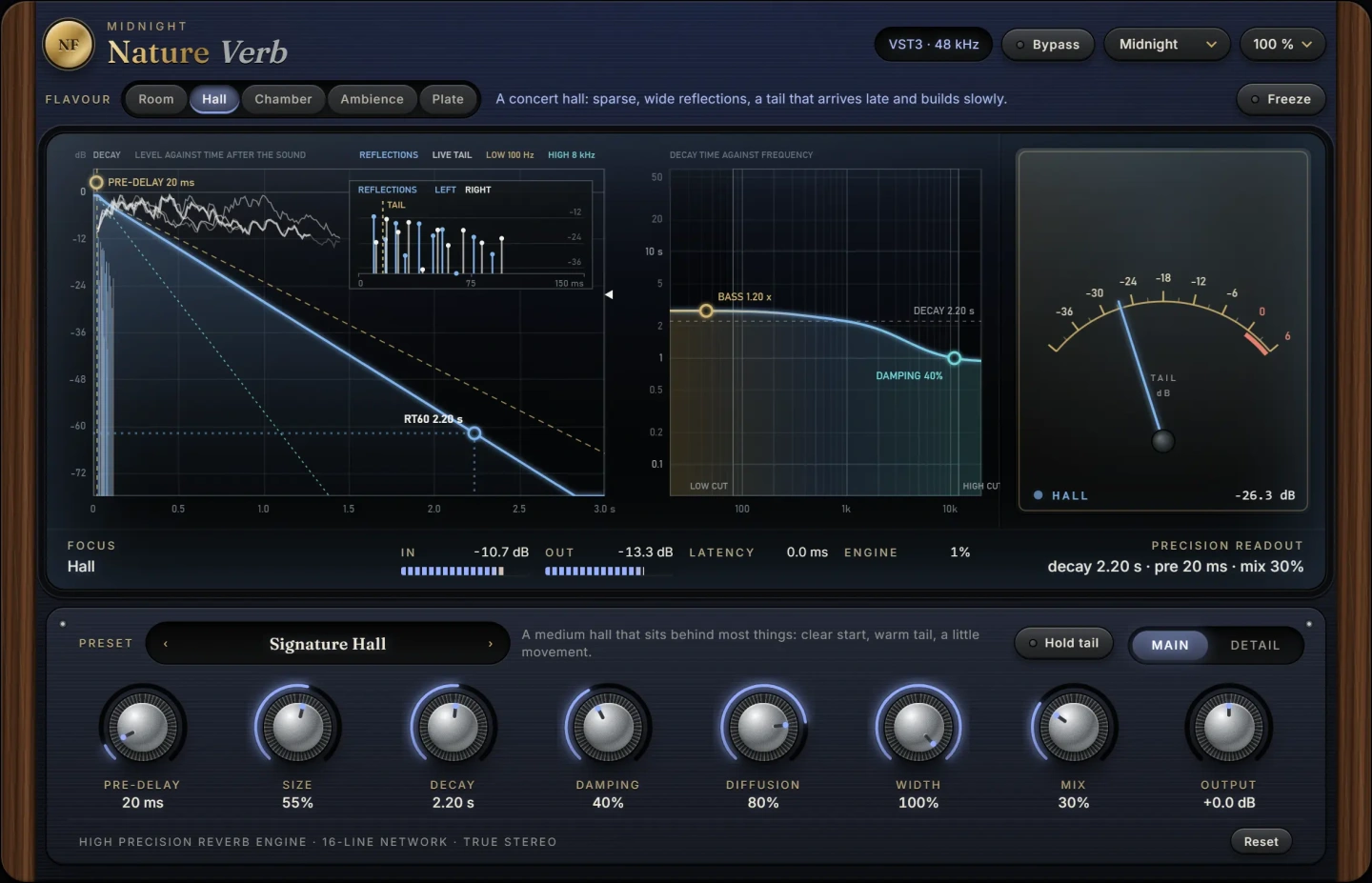
Nature Verb offers room, hall, chamber, ambience and plate, and each flavour is its own build of the algorithm rather than one engine with a different label. Its spaces are built from early reflections and a dense, slowly moving tail, which matches the anatomy above, so you can hear the difference between a room's quick, strong reflections and a plate's instant density. The decay time you set is the decay time you get, which makes the tempo-based approach in step 3 straightforward: pick 1.5 seconds and the tail really lasts 1.5 seconds.
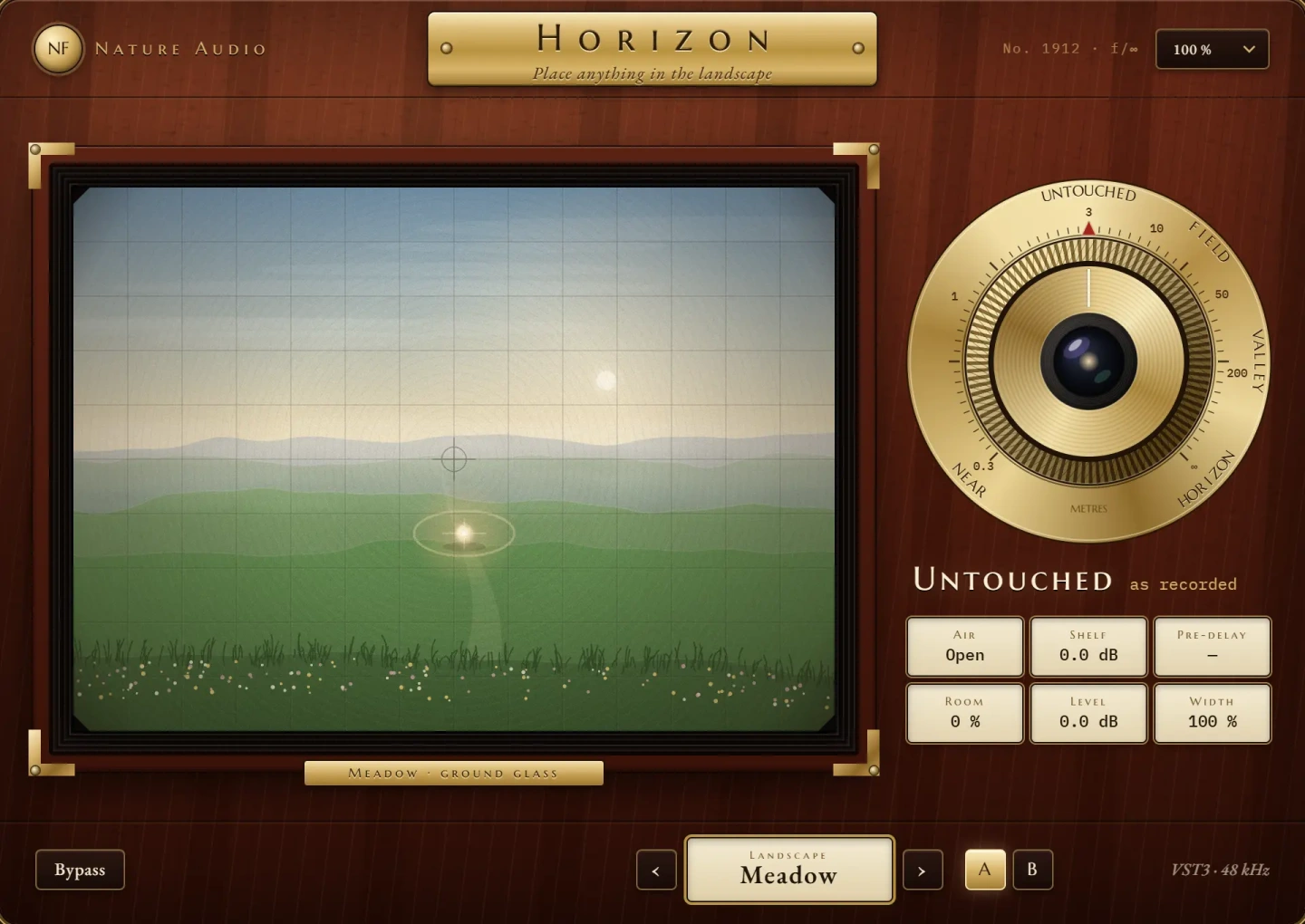
For depth rather than ambience, Horizon places a sound in a landscape from right in front of you to far away. Near adds proximity, presence and air; far takes the highs as air does, softens the attack and brings in the landscape's reflections. A useful pairing is Horizon on the source to set its distance and a shared Nature Verb send to put everything in the same space, so the reverb no longer has to do both jobs.
Common reverb mistakes
- Decay too long for the tempo. Tails overlap and the mix turns to mush, especially in the low mids.
- No EQ on the return. Low-end build-up from reverb is one of the most common causes of a muddy mix.
- Zero pre-delay on vocals. The reverb lands on top of the consonants and the words blur.
- A different reverb on every track. Too many spaces at once sounds unnatural. Two or three shared sends, for example a short room and a plate or hall, usually do more.
- Using reverb for distance alone. Without high-frequency loss and softer attacks, a reverb-heavy source still sounds close, just wet.
Questions
What is the difference between plate and hall reverb?
A hall models a large real space with spread-out early reflections and a long, smooth tail. A plate is a vibrating metal sheet with almost no early reflections, giving a bright, dense sound that adds sheen without the feeling of a big room.
Which reverb type is best for vocals?
Plate is the most common choice because it is bright and smooth and keeps the vocal upfront. Chambers suit a classic, rich sound, short rooms keep a vocal natural and close, and halls suit slow ballads.
What does pre-delay do in reverb?
Pre-delay delays the start of the reverb after the dry sound. Longer pre-delay, around 20 to 80 ms, keeps the source clear and in front; shorter pre-delay places it deeper in the space.
How long should reverb decay be?
Short rooms decay in 0.3 to 1.2 seconds, plates and chambers in about 1 to 2.5 seconds, and halls in 1.8 to 3 seconds or more. Set it so the tail mostly fades before the next phrase or hit.
The plug-ins in this guide
 New
More guides
- How to Make a Sound Sound Far Away in a MixHow to make a sound sound far away in a mix: use level, high-frequency loss, pre-delay, early reflections and softer transients to place…
- Delay on Vocals: Slapback, Throws and Tape vs DigitalHow to use delay on vocals: slapback, 1/8 and 1/4 note throws, filtering and ducking the repeats, plus tape delay vs digital delay and…
- How to Compress Vocals: Ratio, Attack and ReleaseHow to compress vocals: ratio, attack and release settings that work, serial compression for an even vocal, levelling vs character and…