
Guide
Mid Side EQ Explained: When and How to Use It
Mid side EQ explained: how M/S works, when to use it on mixes and masters, side high-pass filters, mono bass, and the phase and width risks to watch.
Mid side EQ splits a stereo signal into what is the same in both speakers (the mid) and what is different between them (the side), so you can equalise each part on its own. It lets you clean low end out of the sides, brighten the edges of a mix without touching a centred vocal, or tame a harsh centre without dulling the stereo ambience. Used gently it is one of the most useful tools in mastering and bus processing.
What mid/side actually is
A normal stereo EQ works on the left and right channels. Mid/side encoding converts those channels into two different ones:
- Mid = (Left + Right) / 2. Everything that sits in the centre: usually the lead vocal, kick, snare, bass and anything panned straight up.
- Side = (Left - Right) / 2. Everything that differs between the speakers: wide guitars, stereo reverb, room mics, panned percussion, stereo synth pads.
The EQ processes mid and side separately, then decodes them back to left and right. If you change nothing, the signal comes back identical. What you gain is a new way to reach parts of the mix that left/right EQ cannot isolate. Note that side is not the same as "the left and right edges": a sound panned hard left exists in both mid and side.
When to use mid side EQ
On a master or mix bus
- High-pass the sides. Low frequencies in the sides make a mix feel loose, waste limiter headroom and cause trouble on mono playback and vinyl. A side high-pass around 80 to 150 Hz, with a gentle 12 dB per octave slope, tightens the low end.
- Add air to the sides. A 1 to 2 dB high shelf above about 8 to 10 kHz on the side channel opens up the stereo image without making the vocal sharper.
- Clear the centre. A small cut of 1 to 2 dB in the mid around 250 to 500 Hz can reduce mud in the vocal and bass region while the wide elements stay full.
- Bring the vocal forward. A gentle mid boost around 2 to 4 kHz lifts presence in the centre, or a small side cut in the same region does it from the other direction.
On individual tracks and buses
- Stereo drum overheads. Cut the mid low-mids to reduce kick and snare build-up, keep the cymbal width.
- Stereo pads and synths. Thin out the mid to leave room for the vocal, so the pad wraps around it instead of sitting on top.
- Reverb returns. High-pass the side of a reverb return to keep low-end wash out of the stereo field.
How to do it, step by step
This works with any EQ that has an M/S mode. Many stock DAW EQs have one, and you can also build it with a mid/side encoder and decoder around two normal EQs.
- Solo the mid, then the side. Most M/S EQs let you listen to each. Hear what lives where before you change anything. On many mixes the side is mostly reverb, guitars and cymbals.
- Start with the side high-pass. Raise the frequency slowly from 20 Hz while listening to the full mix, not the solo. Stop just before the mix feels narrower or smaller in the low mids. That is often between 80 and 150 Hz.
- Make tonal moves on one channel at a time. Keep boosts and cuts to 1 to 3 dB with wide bells. M/S changes are subtle on purpose.
- Check in mono. Mono removes the side completely. Whatever you did to the side disappears in mono, so the mid must stand up on its own.
- Bypass at matched level. Boosting the side makes the mix sound wider and louder at once. Level-match the bypass so you judge tone, not volume.
Mono bass and why it matters
Low frequencies carry most of the energy in a mix. When bass is spread across the sides, the two speakers push slightly different signals, which feels less focused and can partially cancel on mono systems such as phones, club rigs and Bluetooth speakers. Vinyl cutting also needs centred bass. Keeping everything below roughly 100 to 150 Hz in the mid gives you a punchier kick, a steadier bass line and more headroom for the limiter. A side high-pass is the cleanest way to do that without touching the mid at all.
Where Nature EQ helps
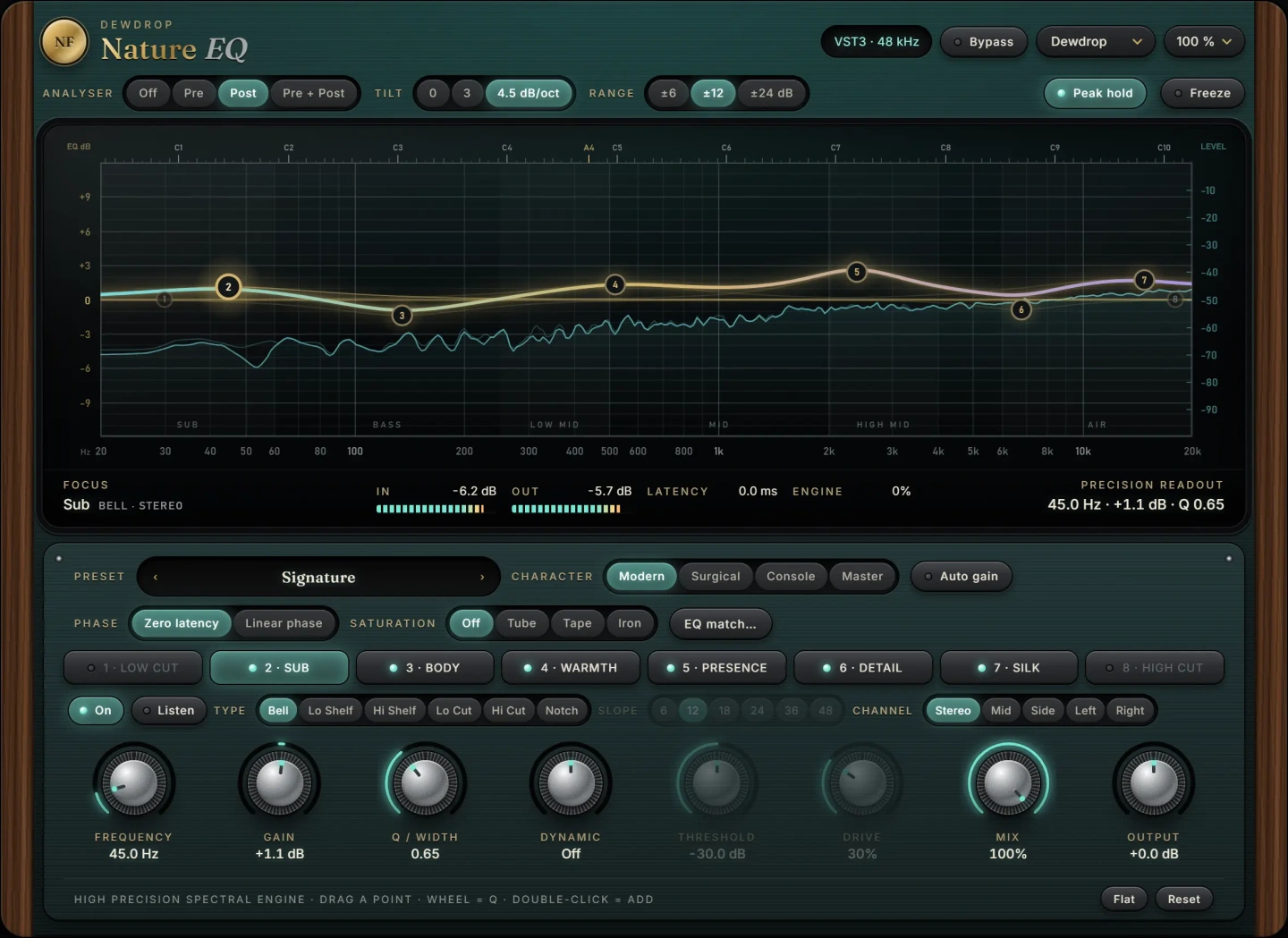
Nature EQ lets every one of its eight bands work on stereo, mid, side, left or right, so you can high-pass the side, shelf the mid and cut a left-channel resonance in the same instance, rather than stacking several EQs. Bells and shelves can also be made dynamic, which suits M/S work well: a side boost in the highs that backs off when cymbals get harsh, or a mid cut in the low mids that only engages when the bass gets heavy. It also offers linear phase, which some engineers prefer when mid and side are processed very differently. It runs as VST3 on macOS and Windows.
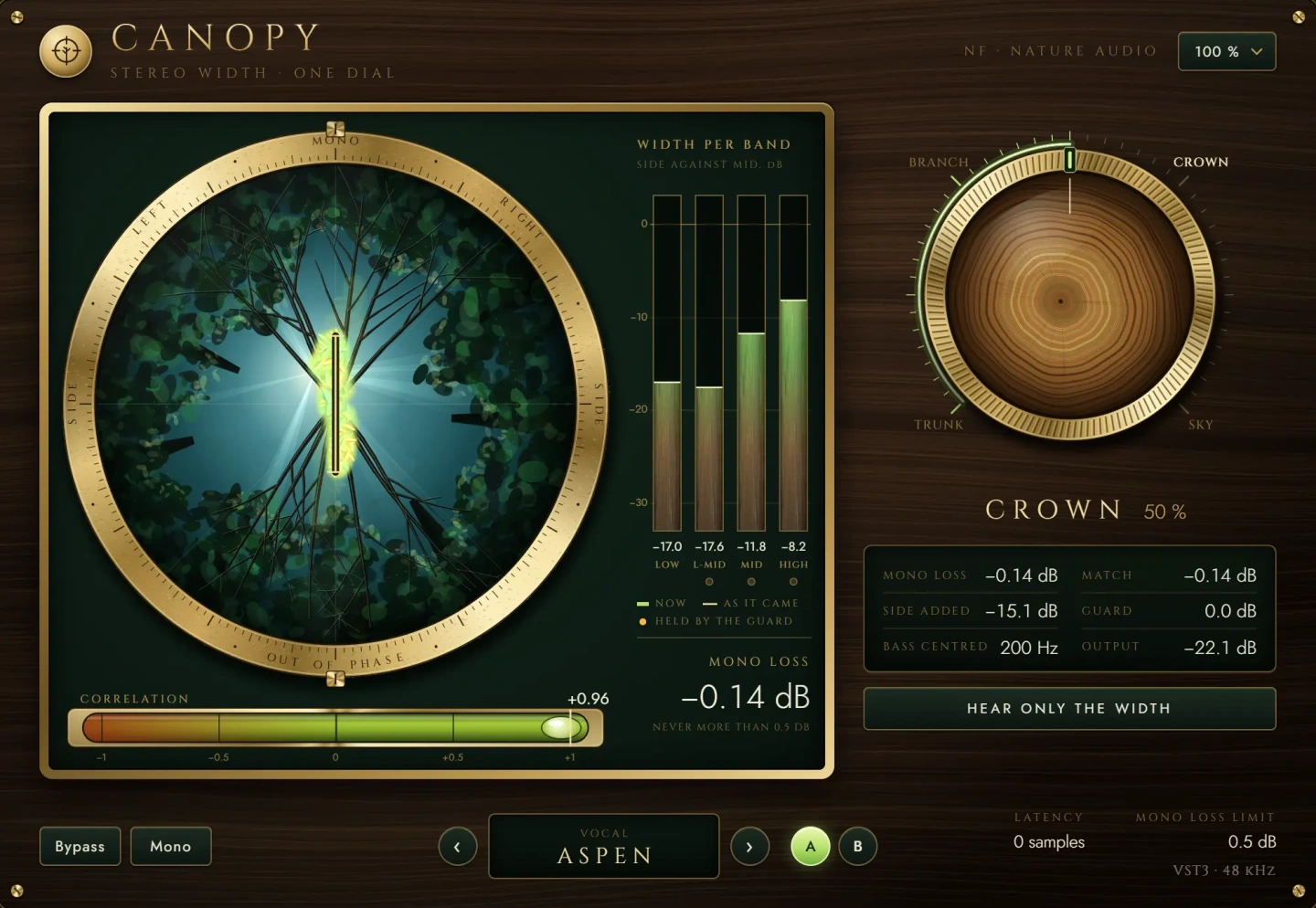
If you need more width rather than a tonal change, EQ on the side is not the only option. Canopy widens a signal while keeping the mono sum as it was and holding the bass in the centre. Our guide to mono compatible stereo widening explains the trade-offs.
Risks and common mistakes
- Boosting the side too far. More than 3 dB of side boost tends to make a mix hollow in the centre, weak in mono and noisy, because reverb tails and room noise come up with it.
- Side high-pass set too high. Above about 200 Hz you start to lose the body of wide guitars and keys. Listen to the full mix as you sweep.
- Phase shift between channels. A minimum-phase EQ applied differently to mid and side changes the timing relationship between them, which can blur the stereo image on steep filters. Gentle slopes, or linear phase, reduce this.
- Using M/S to fix mix problems. If the vocal is too quiet, turn the vocal up in the mix. M/S is for finishing touches.
- Forgetting mono listeners. Every move on the side channel is gone in mono. Always check.
Questions
What does mid side EQ do?
It equalises the centre of a stereo signal and the stereo difference separately, so you can shape the vocal and bass area without changing reverb and wide instruments, and the other way round.
Should I use mid side EQ on the master?
Often, gently. A side high-pass and a small side air shelf are the most common mastering moves. Keep changes to a few decibels and check in mono.
What frequency should I high-pass the sides?
Usually between 80 and 150 Hz. Bass-heavy electronic music can go up to 200 Hz; sparse acoustic mixes may need only 40 to 60 Hz.
Is mid side EQ the same as a stereo widener?
No. A side boost does widen the image, but only in the frequencies you boost. A widener changes the overall stereo spread, and a good one keeps mono compatibility.
The plug-ins in this guide
 New
 New
More guides
- How to Master a Song at Home: A Step-by-Step ChainHow to master a song at home: reference tracks, honest monitoring, an EQ, density, width, clipping and limiting chain, loudness targets…
- How to EQ Vocals: A Step-by-Step GuideHow to EQ vocals step by step: high-pass the rumble, cut mud and nasal honk, then add presence and air. Frequencies, Q settings and common…
- How to Fix Harsh Vocals and Resonances in a MixHow to fix harsh vocals: find harsh resonances at 2-6 kHz, cut them with narrow or dynamic EQ, and smooth a vocal without making it sound…