
Guide
Noise Gate on Drums: Settings That Actually Work
Use a noise gate on drums: set threshold, hysteresis, attack, hold and release, filter the key and choose gate or expander to cut bleed but keep each hit.
A noise gate on drums mutes a track whenever it falls below a threshold, which removes bleed and ring between hits. Set the threshold just under the quietest hit you want to keep, use a very fast attack so transients are not clipped, add 10 to 50 ms of hold, and tune the release so the drum's natural decay survives. Filter the gate's key signal so it opens on the drum and ignores the cymbals.
Why gate drums at all
Every microphone on a kit hears the whole kit. The snare mic picks up hi-hat, the tom mics pick up cymbals, and the kick mic hears everything at a low level. Bleed is not always bad: it gives a kit its sense of room. But it also smears the image, causes phase problems between mics and limits how much EQ and compression you can apply before the bleed becomes louder than the drum. Gating is most common on toms, which play rarely but ring and collect cymbal wash the whole time, then on kick and snare in tight, modern productions.
The controls and what they do
Threshold
The level that opens the gate. Too high and soft ghost notes or quiet tom hits disappear; too low and loud bleed opens it. Watch the gate's meter while the drummer plays a quiet passage and set the threshold just below the softest hit you want.
Hysteresis
Some gates use a separate, lower level for closing than for opening. This difference, often 3 to 10 dB, stops the gate from rattling open and shut when the signal hovers around the threshold during a decay. If your gate chatters, increase the hysteresis before touching anything else.
Attack
How fast the gate opens. On drums keep it very fast, 0.01 to 0.5 ms, or the front of the hit gets cut and the drum loses its snap. A gate with lookahead opens slightly early, which preserves even the sharpest transient.
Hold
How long the gate stays fully open after the signal drops below the threshold. 10 to 50 ms is typical. Hold prevents the gate from closing in the middle of a hit's first decay.
Release
How fast the gate closes after the hold. Short releases of 20 to 80 ms give a tight, dry sound. Toms usually need longer, 100 to 400 ms, so their pitch and body ring out naturally. Set it by ear against the tempo: the gate should be closed before the next unrelated sound arrives.
Range or depth
How much the gate turns the signal down when closed. Full muting, often marked as infinite range, can sound unnatural. A range of 10 to 20 dB lowers the bleed while keeping a little of the room, and it hides any gate movement.
Key filters and external sidechain
The gate decides when to open based on a key signal, normally the track itself. Key filters let you shape what it listens to without changing what you hear. On a snare, high-pass the key around 150 to 200 Hz to ignore kick bleed and low-pass it near 6 to 8 kHz to ignore hi-hat. On a kick, low-pass the key around 100 to 150 Hz so the snare cannot open it. On toms, a band around each tom's fundamental works well.
An external sidechain key goes further. You feed a different signal into the gate's detector, such as a drum trigger, a clean close mic or a MIDI-generated click. A common trick is to gate a room mic or a noise generator from the snare mic, so a burst of ambience or noise follows each hit exactly.
Gate vs expander
A gate is effectively an on-off switch with smooth edges. An expander turns the signal down gradually by a ratio, for example 1:2 or 1:4, as it falls below the threshold. Expansion is gentler and more forgiving with dynamic playing, so it suits jazz, acoustic and live recordings where hard gating would chop ghost notes. A gate suits tight rock and metal, toms in busy mixes and any sound you want fully silent between hits. For steady background noise rather than drum bleed, a dedicated noise reducer is often better; see the guide on removing background noise from audio.
Step by step on a snare (any gate)
- Insert the gate before compression, so the compressor does not raise the bleed you are trying to remove.
- Set attack to the fastest value, hold to 20 ms, release to 100 ms and range to full.
- Turn on key listen if your gate has it. High-pass the key at 150 Hz and low-pass at 7 kHz until mostly the snare comes through.
- Lower the threshold from the top until every hit opens the gate, including ghost notes you want to keep.
- Adjust release until the decay sounds natural and the gate closes before the next hi-hat.
- Reduce range to 12 to 20 dB if the result sounds too clipped or the kit loses its space.
- Listen in context with all drum mics up. A gate that sounds strange in solo can be perfect in the mix.
For toms with very few hits, many engineers skip the gate and simply edit out the silence by hand. It is slower but completely transparent.
Where Nature Gate makes it faster
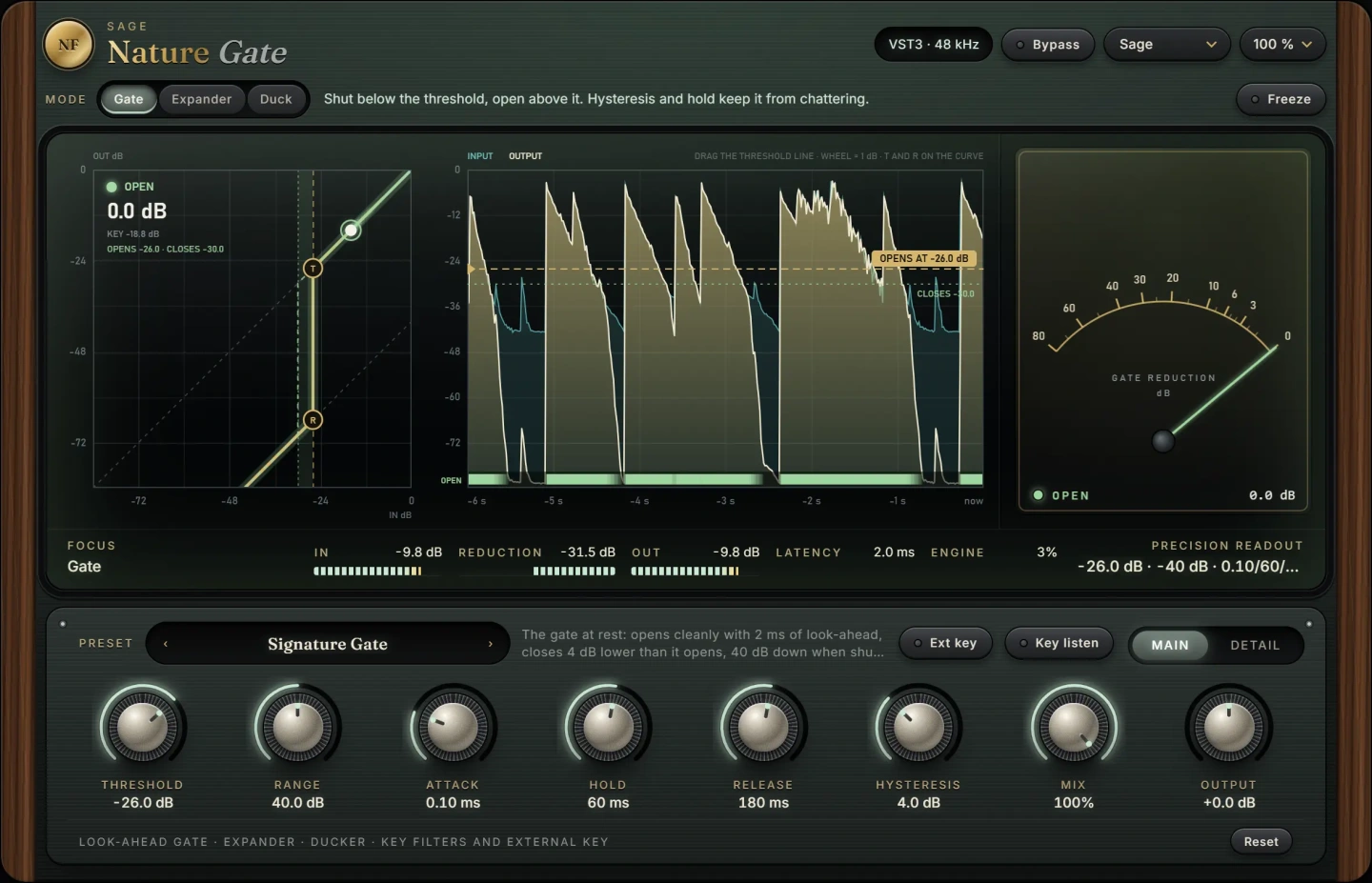
Nature Gate closes the gaps between the notes. It works as a gate, a gentler expander or a ducker, with its own filters on the key so it opens on what you mean and nothing else. That covers the main decisions in this guide in one plug-in: switch to the expander for a dynamic jazz kit, use the key filters to keep cymbals from opening the tom gates, and use the side-chain key to trigger the gate from another source. It runs as VST3 on macOS and Windows.
Common mistakes
- Slow attack. The most common cause of gated drums that sound weak. Keep it near zero or use lookahead.
- Release too short on toms. The tom becomes a click. Let it ring.
- Gating after heavy compression. Compression shrinks the gap between hit and bleed, making the threshold hard to set.
- Losing ghost notes. If quiet hits matter, use an expander or a lower range instead of a hard gate.
- Not checking the overheads. Gating close mics changes the phase relationship with the overheads each time the gate opens. Listen to the whole kit when deciding.
Once the bleed is under control, compression behaves much more predictably. The guide on VCA, FET and opto compressors helps you choose the next step.
Questions
Should I gate the kick drum?
In tight modern rock, metal and pop, often yes, with a low-passed key so the snare cannot open it. In looser, roomier styles, a gentle expander or no gate at all may sound better.
Gate before or after compression on drums?
Usually before. The gate then sees a clear difference between the hit and the bleed, and the compressor does not lift the bleed back up.
Why does my gate chatter?
The signal is hovering around the threshold. Add hysteresis, lengthen the hold, or lower the threshold slightly so the decay does not keep crossing it.
What is a good release time for a gate on toms?
Start around 200 ms and adjust to the tempo and the tom's pitch. Floor toms often need 300 ms or more to keep their body.
The plug-ins in this guide
 New
More guides
- How to Remove Mic Bleed From a RecordingHow to remove mic bleed: prevent it at the session, then use gating, EQ, phase alignment, expanders and dedicated tools on drums, vocals…
- Sidechain Compression Without a Sidechain: PumpingHow to get sidechain compression without a sidechain: the classic kick-keyed pumping effect explained, then faster shortcuts that skip the…
- Delay on Vocals: Slapback, Throws and Tape vs DigitalHow to use delay on vocals: slapback, 1/8 and 1/4 note throws, filtering and ducking the repeats, plus tape delay vs digital delay and…