
Guide
How to Mix Kick and Bass So They Work Together
How to mix kick and bass: decide who owns the sub, carve EQ space, duck the bass under the kick, check phase and keep the low end mono for a solid bottom.
To mix kick and bass, decide which one owns the lowest octave, carve a little space for the other with EQ, and duck the bass briefly whenever the kick hits. Then check that the two are in phase and that everything below about 100 Hz sits in mono. Get those four things right and the low end becomes solid instead of boomy.
Why kick and bass fight
Both instruments put most of their energy in the same range, roughly 40 to 120 Hz. When they play together, their waveforms add up. Sometimes that reinforces, sometimes it cancels, and the result changes from note to note. You hear it as a low end that is huge on one beat and thin on the next, or as a mix that gets loud on the meters without sounding loud. The goal is not to separate them completely but to give each a clear role.
Step 1: decide who owns the sub
Listen to the arrangement and choose. In most hip-hop, trap and many electronic styles, an 808 or sub bass owns 30 to 60 Hz and the kick provides the click and punch above it. In rock, funk and house with a punchy kick, the kick often owns 50 to 70 Hz and the bass sits slightly higher, with its weight around 80 to 120 Hz and its definition from the harmonics above. Writing this down as a sentence helps: "the kick is the thump at 60 Hz, the bass is the body at 100 Hz".
Step 2: tune and arrange first
A kick with a clear pitch should agree with the key of the song. If your kick rings at a note that clashes with the bass line, retune the kick sample before reaching for EQ. Also look at the rhythm. If the bass plays long notes that start exactly on every kick, they will always compete. Shortening bass notes slightly, or leaving space for the kick, does more than any plug-in.
Step 3: carve with EQ
- High-pass both. Remove what neither needs, usually below 25 to 30 Hz, so subsonic energy does not eat headroom.
- Find the kick's fundamental with a narrow boost sweep, often between 45 and 70 Hz. Give it a modest boost of 2 to 3 dB if it needs weight.
- Cut the bass by 2 to 4 dB at that same frequency with a medium Q. Do the reverse higher up: if the bass body lives at 100 Hz, a small cut there on the kick helps.
- Cut boxiness on the kick around 250 to 400 Hz, and give the bass its definition in the 700 Hz to 2 kHz range so it reads on small speakers.
Keep moves small. Two cuts of 3 dB in complementary places do more than one deep notch.
Step 4: duck the bass under the kick
Sidechain compression is the standard tool. Put a compressor on the bass, feed the kick into its sidechain input, and set a fast attack (0.1 to 1 ms), a release of 50 to 150 ms tuned so the bass returns before the next beat, and 2 to 6 dB of gain reduction. The bass steps aside for the kick's first moment, then comes back. For a more obvious pumping effect, raise the depth and lengthen the release.
If you only want to duck the lows, use a multiband compressor or a dynamic EQ band below 120 Hz keyed from the kick, so the bass keeps its mid-range growl while the sub moves out of the way. If your setup makes sidechain routing awkward, the guide on sidechain pumping without a sidechain covers the alternatives.
Step 5: check phase and polarity
Solo the kick and bass together and flip the polarity of the bass. If the low end gets fuller, keep it flipped. If it gets thinner, flip it back. With layered kicks or a bass recorded through both DI and amp, line up the waveforms by nudging one a few milliseconds until the low end is at its strongest. Do this before EQ, because filters shift phase too.
Step 6: keep the low end mono
Stereo bass sounds wide on headphones but partly cancels on mono systems, and club rigs often sum the subs to mono. Keep everything below roughly 100 to 150 Hz centred. Many stereo tools have a bass mono or crossover setting for this. The guide on mono compatible stereo widening explains how to widen the rest without losing the bottom.
Step 7: help the bass on small speakers
Phones and laptops cannot play 50 Hz. Add harmonics with gentle saturation, or generate them with a sub harmonic or bass enhancer, so the listener hears the pitch through its overtones. Going the other way, a sub octave generator can add weight to a thin bass, but use it with care and keep it in mono.
Where NF Audios plug-ins make it faster
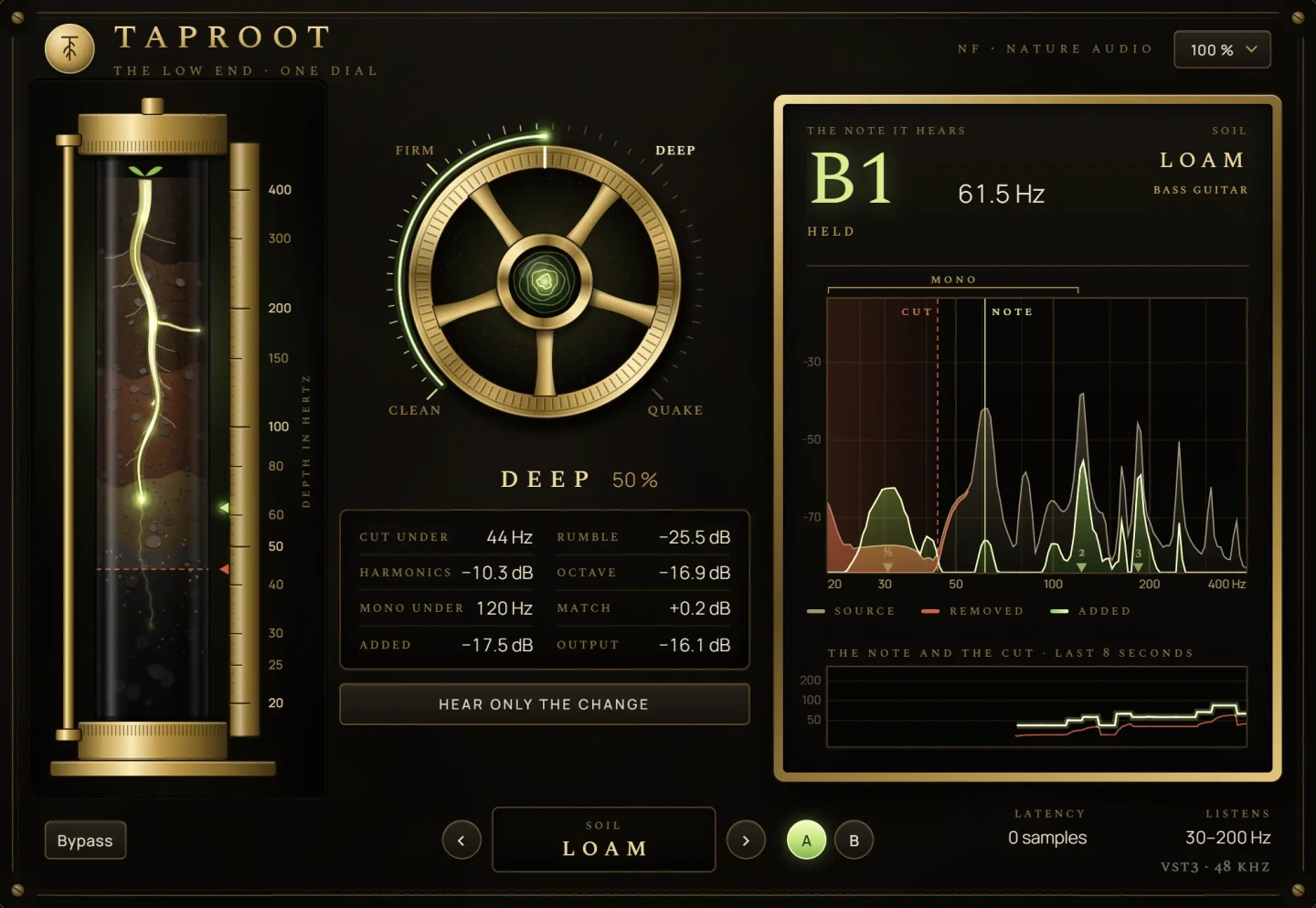
Taproot handles several of these steps on one dial. It hears the note the bass is playing, cuts only the rumble under that note, adds the octave below and the harmonics above it in tune, and keeps the bottom in the centre. Because the cleanup and the added harmonics follow the note, you do not have to chase a different EQ setting for every pitch in the bass line, and the mono low end is taken care of in the same place.
Undertow makes a sound duck on every beat and swell back, the pumping of side-chain compression without setting up a side-chain. One lever sets how deep the pull is and how it returns. It suits four-on-the-floor patterns where the kick lands on the beat. If your kick pattern is syncopated, a keyed compressor following the actual kick will be more precise. Both plug-ins are VST3 for macOS and Windows.
Common mistakes
- Soloing to set the low end. Balance kick and bass with the full mix playing, at moderate volume.
- Boosting both in the same place. If you add 60 Hz to the kick and 60 Hz to the bass, you have only made the conflict louder.
- Trusting one pair of speakers. Check on headphones, small speakers and in mono. A spectrum analyser helps when your room has bass problems.
- Too much ducking. More than about 6 dB on the bass often sounds like an effect. Fine if you want it, distracting if you do not.
- Forgetting the kick tail. A long 808-style kick and a sustained bass will always overlap. Shorten one of them.
Questions
Should the kick or the bass be louder?
It depends on the genre. In most modern pop, hip-hop and electronic music the kick peaks slightly above the bass, while the bass carries more steady energy. Reference a commercial track you like and match the balance.
What frequency should I cut on the bass for the kick?
Cut where the kick's fundamental sits, usually between 45 and 70 Hz. Find it by sweeping a narrow boost on the kick, then apply a 2 to 4 dB cut at that frequency on the bass.
Should bass be mono?
The low end should be. Keep content below about 100 to 150 Hz centred. Upper harmonics of a bass synth can be stereo if the mix stays solid in mono.
Do I need sidechain compression for kick and bass?
Not always. Good arrangement and EQ can be enough. Sidechain ducking helps most when the kick and bass play at the same time with similar low-frequency weight.
The plug-ins in this guide
 New
 New
More guides
- Sidechain Compression Without a Sidechain: PumpingHow to get sidechain compression without a sidechain: the classic kick-keyed pumping effect explained, then faster shortcuts that skip the…
- Delay on Vocals: Slapback, Throws and Tape vs DigitalHow to use delay on vocals: slapback, 1/8 and 1/4 note throws, filtering and ducking the repeats, plus tape delay vs digital delay and…
- How to Compress Vocals: Ratio, Attack and ReleaseHow to compress vocals: ratio, attack and release settings that work, serial compression for an even vocal, levelling vs character and…