
Guide
Transient Shaper: How to Make Drums Punchier
How a transient shaper works and how to use one to make drums punchier or softer: attack vs sustain, when to choose it over compression, and drum bus tips.
A transient shaper changes the attack and the sustain of a sound directly, without a threshold. Turn the attack up to make drums punchier and more defined, turn it down to soften them; raise the sustain to bring out room and body, lower it to make the hits tighter. Because it responds to the shape of each hit rather than its level, it works the same on soft and loud playing.
Attack and sustain
Every drum hit has two parts. The transient is the first few milliseconds: the stick on the head, the beater on the kick, the click that tells your ear where the beat is. The sustain is what follows: the drum's body, its ring and the room. Punch is mostly about the contrast between them. A sharp transient over a short, controlled sustain reads as punchy. A rounded transient over a long sustain reads as soft, big or distant.
A transient shaper usually follows the signal with two envelope detectors, one fast and one slow. Where the fast one rises above the slow one, the sound is in its attack phase, and the plug-in applies the attack gain. Afterwards it applies the sustain gain. The result is a level-independent tool: a ghost note and a rimshot both get the same relative treatment.
Transient shaper vs compressor
A compressor can also change punch. With a slow attack, around 10 to 30 ms, it lets the transient pass and then clamps down, which emphasises the hit. With a fast attack it shaves the transient off. The differences:
- A compressor reacts to level, so it treats loud hits more than quiet ones. That is useful for evening out a performance.
- A transient shaper reacts to shape, so it leaves the performance's dynamics alone and only changes the envelope of each hit.
- A compressor's release interacts with tempo and can pump. A transient shaper has fewer settings to tune and rarely pumps.
Use a compressor when you need control, a transient shaper when you need shape. Many mixes use both: a shaper for the envelope and a compressor for consistency. The guide on VCA, FET and opto compressors explains which compressor types emphasise attack best.
How to make drums punchier, step by step
- Start with the kick and snare individually. Insert the shaper on the close mic or sample. Raise the attack by a small amount, roughly 2 to 4 dB of emphasis if your plug-in shows it in dB, until the hit steps forward.
- Trim the sustain if the drum rings or the room is too big. Lowering sustain by 3 to 6 dB tightens a kick and makes room for the bass. It also reduces bleed between hits, a softer alternative to a gate.
- Check the peaks. Boosting attack raises peak level, sometimes by several dB. Watch for clipping on the channel and later on the master, and leave headroom.
- Move to the drum bus. A modest attack boost on the bus brings the whole kit forward. Keep it lighter than on single drums, because cymbals and hi-hats are full of transients and will get sharper too.
- Compare at matched level. Gain match the processed and bypassed signal. More attack often sounds better simply because it sounds louder.
Making drums softer
The same tool works in reverse. Reduce attack to tame a harsh snare, a clicky kick sample or spiky programmed hats. Combine reduced attack with increased sustain for big, washy room drums or for pushing a loop into the background behind a vocal. This is gentler than a low-pass filter because the tone stays intact; only the edge is softened.
Adding density without losing punch
A shaper changes the outline of the hit. Sometimes the problem is in the middle: the details between hits, room tone and ghost notes are too quiet, so the kit sounds thin even with strong attacks. That is a job for upward compression or a density processor, which lifts low-level detail while holding peaks. Put density after the transient shaper so the shaped attacks are preserved, and use a light touch on the drum bus.
Where NF Audios plug-ins make it faster
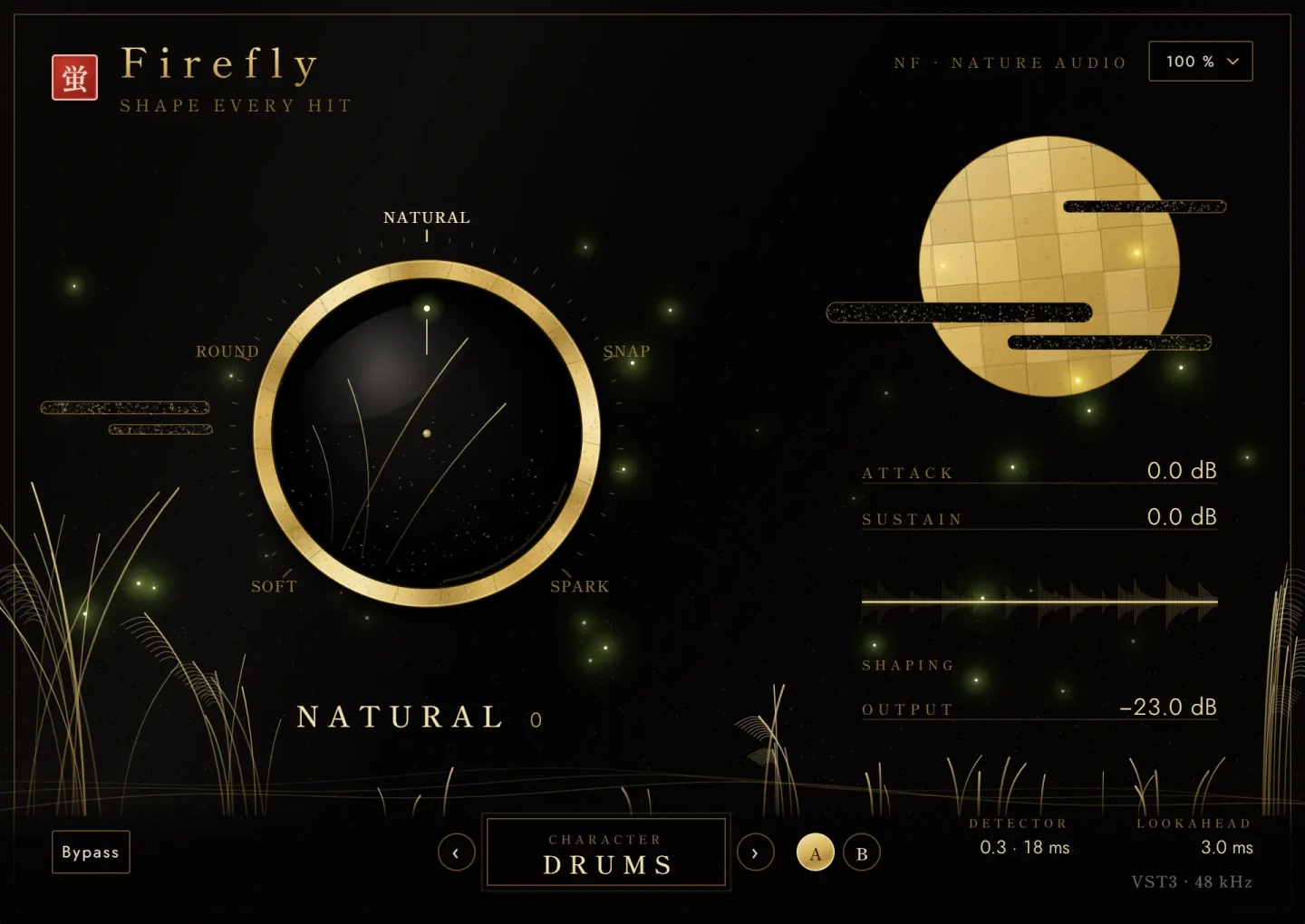
Firefly shapes every hit with one control. Turn it one way and attacks soften and round off; turn it the other and they snap and spark, with the tail following. That maps directly onto the two directions in this guide: punchier for a kick that is lost in the mix, softer for a snare that is too sharp. Because it is a single control, it is quick to audition on each drum and on the bus.
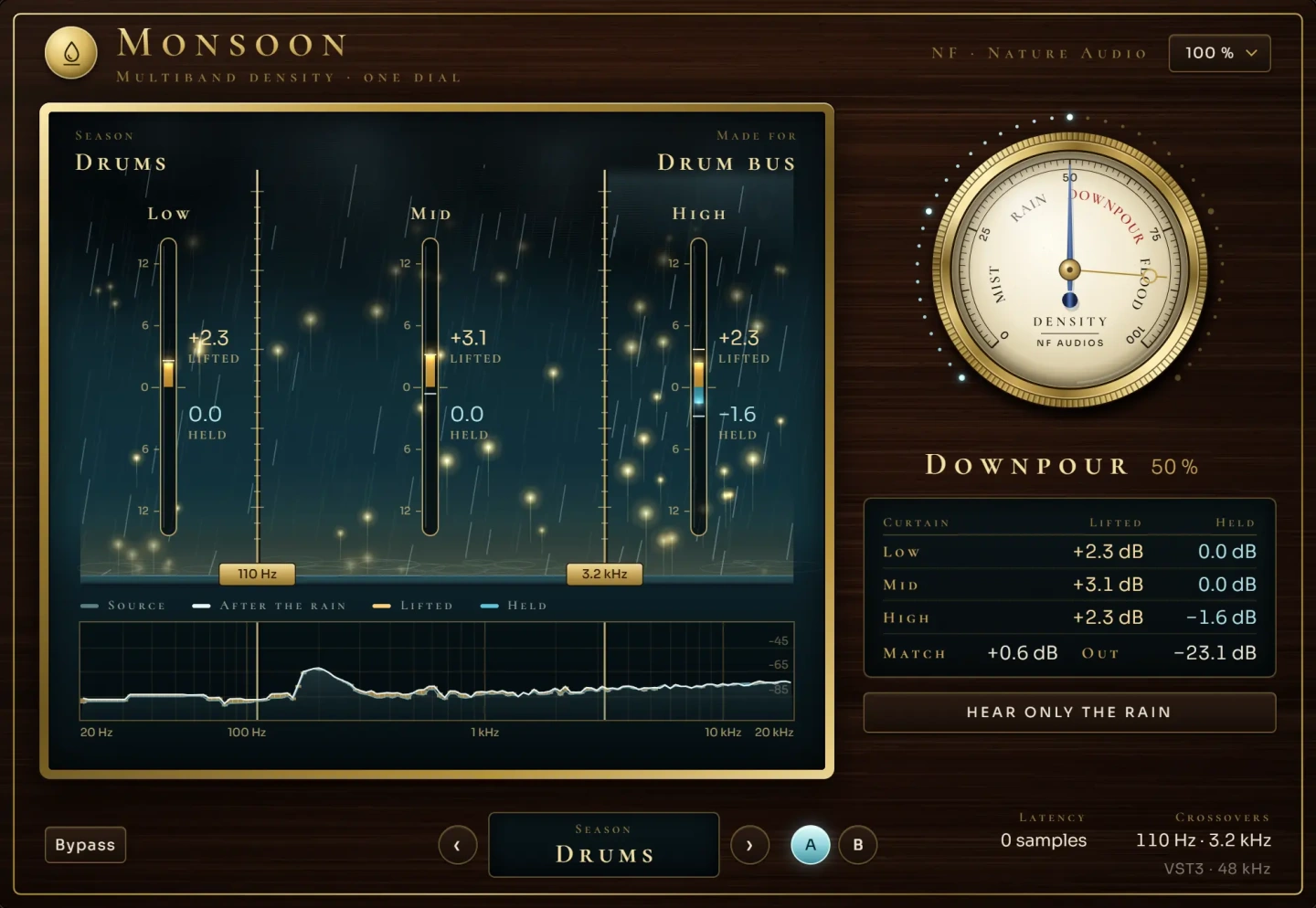
Monsoon handles the density side. It is multiband density on one dial: in three bands it lifts quiet detail and holds peaks, each measured against that band's own level, so there is no threshold to set and it behaves the same at any gain. On a drum bus after Firefly, it fills in the space between hits without flattening the attacks you just shaped. Both are VST3 plug-ins for macOS and Windows.
Common mistakes
- Too much attack on the bus. Cymbals turn brittle and the mix gets tiring. Shape individual drums first.
- Ignoring the peaks. Extra attack can push a mix into the limiter much harder. If the master then sounds squashed, see the guide on clipper vs limiter.
- Shaping before fixing phase. If the kick mics are out of phase, adding attack only makes the problem louder. Check polarity and alignment first.
- Using sustain to fake room. Raising sustain also raises bleed and noise. If you need space, a short reverb is often cleaner.
- Treating every drum the same. A kick may need more attack and less sustain, while toms need the opposite.
Questions
What does a transient shaper do?
It turns up or down the first moment of each sound, the attack, and the part after it, the sustain, independently of how loud the sound is.
Transient shaper or compressor for punch?
For pure punch without changing the performance's dynamics, a transient shaper is simpler. A compressor with a slow attack can do it too and also evens out levels.
Should I use a transient shaper on the drum bus?
Yes, in moderation. A small attack boost on the bus adds cohesion and punch, but shape individual drums first and watch the cymbals.
Can a transient shaper reduce room sound?
Yes. Lowering the sustain reduces ring and ambience after each hit, which makes room-heavy recordings sound tighter and closer.
The plug-ins in this guide
 New
More guides
- How to Master a Song at Home: A Step-by-Step ChainHow to master a song at home: reference tracks, honest monitoring, an EQ, density, width, clipping and limiting chain, loudness targets…
- How to Make a Master Louder: Clipper vs LimiterHow to make a master louder without distortion: clipper vs limiter, LUFS targets, -1 dBTP true peak, streaming normalisation and a gain…
- Delay on Vocals: Slapback, Throws and Tape vs DigitalHow to use delay on vocals: slapback, 1/8 and 1/4 note throws, filtering and ducking the repeats, plus tape delay vs digital delay and…