
Guide
Phaser vs Flanger vs Chorus: Modulation Explained
Phaser vs flanger vs chorus: how each modulation effect works, how vibrato, tremolo and rotary differ, and which sounds best on guitar, synths and vocals.
A phaser uses all-pass filters to sweep a few notches through the sound, a flanger mixes in a very short, moving delay to create a deep comb of notches with a jet-like whoosh, and a chorus uses a slightly longer moving delay to sound like several players at once. All three are built from the same idea, a modulated copy of the signal mixed with the original, but the delay times and the way they are made give each its own character.
How modulation effects work
Most modulation effects have a low-frequency oscillator (LFO) that slowly moves one parameter up and down, a few times per second or slower. The rate sets how fast it moves, the depth how far. Many add feedback, which sends part of the output back to the input and makes the effect more resonant, and a mix control that sets how much of the processed copy you hear. What changes between effects is what the LFO is moving.
Phaser
A phaser passes the signal through a chain of all-pass filters. They do not change the level of any frequency; they shift its phase. When the shifted copy is mixed back with the dry signal, certain frequencies cancel and form notches. Each pair of filter stages makes one notch, so a 4-stage phaser has 2 notches and an 8-stage one has 4. The LFO sweeps those notches up and down.
Because the notches are few and not evenly spaced, a phaser sounds smooth and swirling rather than metallic. Typical settings: rate 0.1 to 1 Hz, moderate depth, low to medium feedback.
Where it suits: funk and rock rhythm guitar, electric piano, synth pads, and slow sweeps on a whole loop or drum bus in electronic music.
Flanger
A flanger mixes the signal with a copy delayed by a very short, changing amount, usually between about 0.5 and 10 ms. A fixed short delay creates a comb filter: many evenly spaced notches across the spectrum. As the LFO changes the delay, the whole comb slides up and down, which gives the classic jet-plane or tape-flange sweep. Feedback makes the peaks between notches ring and sounds more metallic.
Typical settings: rate 0.05 to 0.5 Hz for slow sweeps, high feedback for drama, low feedback for subtle movement.
Where it suits: guitar solos and riffs, drum overheads and hi-hats for a dramatic sweep, risers and transitions, and vocals for a special moment rather than a whole song.
Chorus
A chorus also uses a modulated delay, but a longer one, roughly 10 to 30 ms, with little or no feedback. At that length the ear no longer hears a comb sweep. Instead it hears a slightly delayed copy whose pitch drifts very slightly as the delay changes, like a second player who is never quite in tune or in time. Stereo choruses often use different LFO phases on each side, which makes the sound wider.
Typical settings: rate 0.3 to 1.5 Hz, low depth, mix around 30 to 50 percent.
Where it suits: clean guitar, synth pads and leads, fretless and synth bass (keep the low end dry), backing vocals and string sections that need to sound bigger.
Vibrato, tremolo and rotary
Vibrato
Vibrato is a chorus with no dry signal: you hear only the delayed copy, so the moving delay becomes a pure, regular pitch wobble. Rates of 4 to 7 Hz mimic a singer or string player; slow, deep settings give a seasick, warped-tape feel.
Tremolo
Tremolo modulates volume, not time or pitch. The LFO turns the level up and down. A sine wave gives a gentle pulse, a square wave gives a choppy stutter. Sync the rate to the tempo, often eighth or sixteenth notes. It suits surf and vintage guitar, electric piano, and rhythmic pads.
Rotary
A rotary effect imitates a rotating speaker cabinet, where a spinning horn and drum throw the sound around the room. The result combines pitch shift from the Doppler effect, volume change and stereo movement, usually with slow and fast speeds. It is the classic organ sound and also works on guitar and vocals.
How to choose, step by step
- Decide what you want to change. Width and thickness: chorus. Swirl and movement in the tone: phaser. A dramatic sweep: flanger. Pitch wobble: vibrato. Rhythm in the volume: tremolo. Motion around the room: rotary.
- Start with a low mix and slow rate. Raise depth until you can just hear it, then decide if you want more.
- Sync to tempo where it helps. Tremolo and slow phaser sweeps sound intentional when locked to bars or beats.
- Protect the low end. Modulation on bass frequencies blurs the foundation and can cause phase problems in mono. Put the effect on a send or high-pass the processed signal around 150 to 250 Hz.
- Check in mono. Wide stereo choruses can partly cancel when summed.
Every DAW ships with at least a chorus and a flanger, and these steps work with any of them.
Where Nature FX Board helps
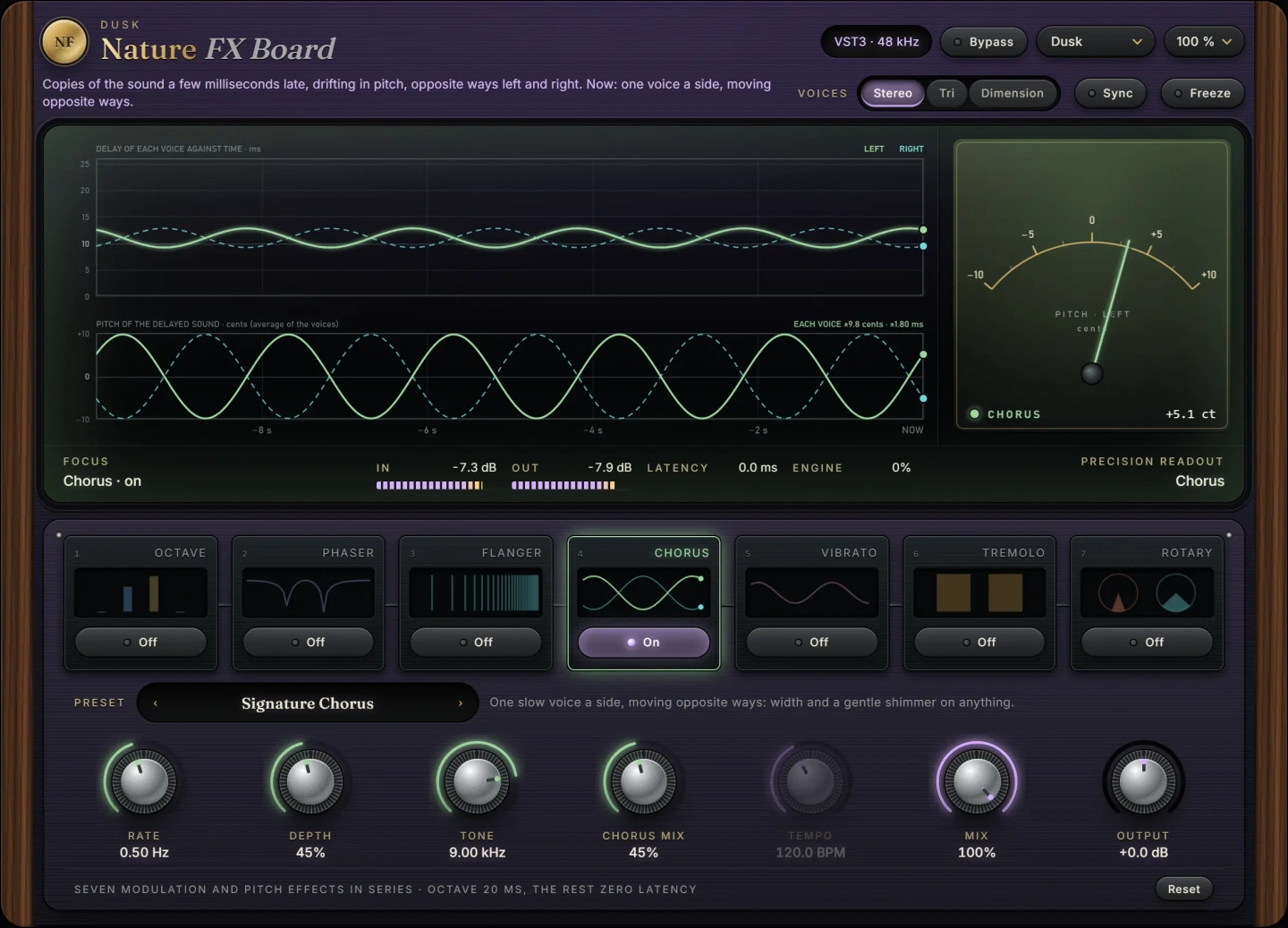
Nature FX Board puts seven effects in a row, each with its own switch: Octave, Phaser, Flanger, Chorus, Vibrato, Tremolo and Rotary. That makes it easy to compare a phaser against a flanger on the same part in one plug-in, or stack a chorus and a tremolo as you would with pedals. Anything switched off is out of the signal entirely, so unused stages do not colour the sound. It runs as VST3 on macOS and Windows.
Modulation also pairs well with other character effects. For older textures, see our guide on making music sound vintage with a lo-fi tape effect, where slow pitch drift plays a big part.
Common mistakes
- Too much depth and rate at once. Fast, deep modulation sounds seasick. Push one, not both.
- Modulating everything. If every part has chorus, nothing sounds wide. Pick one or two elements.
- Chorus on the bass low end. It weakens the fundamental. Keep the lows dry.
- Ignoring feedback. High feedback on a flanger or phaser can build up sharp, loud resonances. Watch your levels.
- Forgetting order. Modulation before distortion sounds different from after it. Before is more aggressive; after is cleaner and more spacious.
Questions
What is the difference between a phaser and a flanger?
A phaser uses all-pass filters to create a few unevenly spaced notches, which sounds smooth. A flanger uses a very short delay to create many evenly spaced notches, which sounds more metallic and jet-like.
Is chorus the same as flanger?
They use the same building block, a modulated delay, but chorus uses a longer delay and little feedback, so it sounds like doubling rather than a sweep.
Which modulation effect is best for vocals?
Chorus is the most common, usually subtle and on backing vocals. Flanger and phaser are better as short special effects on a lead.
Should modulation go before or after reverb?
Usually before. Modulating the dry sound and then adding reverb sounds natural; modulating a reverb tail gives a more washy, ambient effect.
The plug-ins in this guide
 New
More guides
- Delay on Vocals: Slapback, Throws and Tape vs DigitalHow to use delay on vocals: slapback, 1/8 and 1/4 note throws, filtering and ducking the repeats, plus tape delay vs digital delay and…
- How to Compress Vocals: Ratio, Attack and ReleaseHow to compress vocals: ratio, attack and release settings that work, serial compression for an even vocal, levelling vs character and…
- How to EQ Vocals: A Step-by-Step GuideHow to EQ vocals step by step: high-pass the rumble, cut mud and nasal honk, then add presence and air. Frequencies, Q settings and common…